DEVELOPMENT ALTERNATIVES, INC. (DAI)
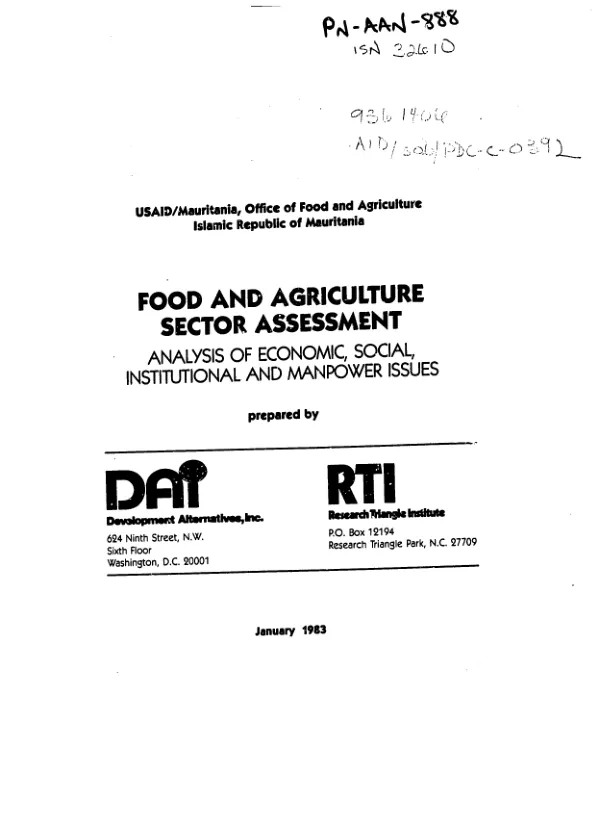
Analysis of economic, social, institutional and manpower issues
Economic, social, and manpower/institutional analyses of Mauritania"s food and agricultural sectors are provided in three separate papers.
Shearer, Eric B. · 1983
Sign in to readA free account is required to download.
Abstract
Stressing the unreliability of available data, the first paper assesses: the country"s largely nomadic and externally dependent economy; the relatively small economic role played by the rural primary sector; the food production-consumption gap; grain prices and price policies; and rural income and food consumption patterns. It is concluded that the costs entailed by infrastructural constraints and institutional inefficiencies would doom outside agricultural investment from the outset. The social analysis covers historical factors shaping Mauritanian society and the main socioethnic groups (Moors and Black Africans); factors of social change such as colonization, drought, and migration patterns; and pressing social issues related to agricultural development (e.g., land tenure, sedentarization of nomads, participation, and the role of women). The final paper evaluates: educational, training, and manpower development in Mauritania; public and private bureaucracies in light of the sociopolitical milieu; and overall institutional capacity. It is concluded that manpower skills are lower than in most developing countries and that the capacity for developing public institutions is very limited. Suggestions for reallocating government resources and involving private sectors in development conclude the study.