USAID DEC
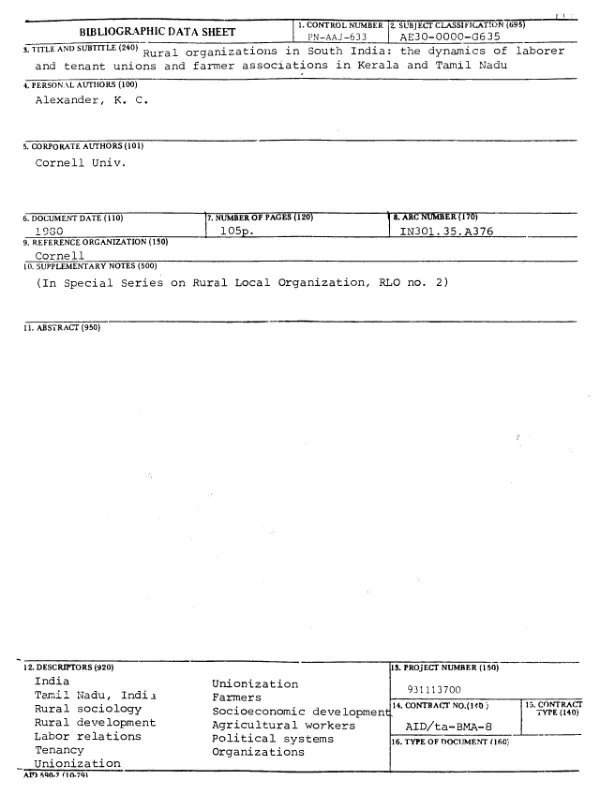
RURAL ORGANIZATIONS IN SOUTH INDIA : THE DYNAMICS OF LABORER AND TENANT UNIONS AND FARMER ASSOCIATIONS IN KERALA AND TAMIL NADU
Sign inCORNELL UNIVERSITY
RURAL ORGANIZATIONS IN SOUTH INDIA : THE DYNAMICS OF LABORER AND TENANT UNIONS AND FARMER ASSOCIATIONS IN KERALA AND TAMIL NADU
Rural organizations, prominent features in agrarian development, are capable of transforming political and socioeconomic relationships.
ALEXANDER, K. C. · 1970
Sign in to readA free account is required to download.
Abstract
This study examines the emergence of peasant organizations in the Indian districts of Kerala and Tamil Nadu. The report describes the various agricultural laborer and tenant organizations and tiller and farmer associations and the factors affecting membership and participation. These organizations are also analyzed in light of several theories of peasant mobilization which claim peasant movements result from deteriorating economic conditions, depend upon a geographically or organizationally concentrated rural proletariat, and require a perception of traditional institutions and relations as illegitimate. Investigation is made of various changes in agrarian relations, such as the radical tenure reforms in Kerala and the improvement of patron-client relations in Alleppy, Tamil Nadu, which have yielded substantial economic and social improvement. The report addresses the political polarization which peasant movements have brought about. Whereas unorganized peasants are deprived of almost all political power in the village, organized peasants increasingly defend their interests in the political arena, often with the aid of the Indian Communist Party (CP). On the other hand, caste, except in the case of the Harijan caste which is dominant among rural laborers, has impeded peasant unity. The division of the peasantry between landless laborers and those employed on their own small holdings is an additional and powerful barrier to solidarity. Many small farmers with marginal holdings have joined larger farmers in forming groups such as the All-Kuttanad Farmers Association which are antagonistic to the CP and its efforts on behalf of the landless. Also, neither the inability of cropping systems to satisfy demand, the deplorable level of living, nor the infusion of capitalism have been sufficient to mobilize peasants. Thus, the report concludes that India"s poor are divided into hostile groups which for the time being will prevent development of organizations embracing all sections of the rural poor.