USAID DEC
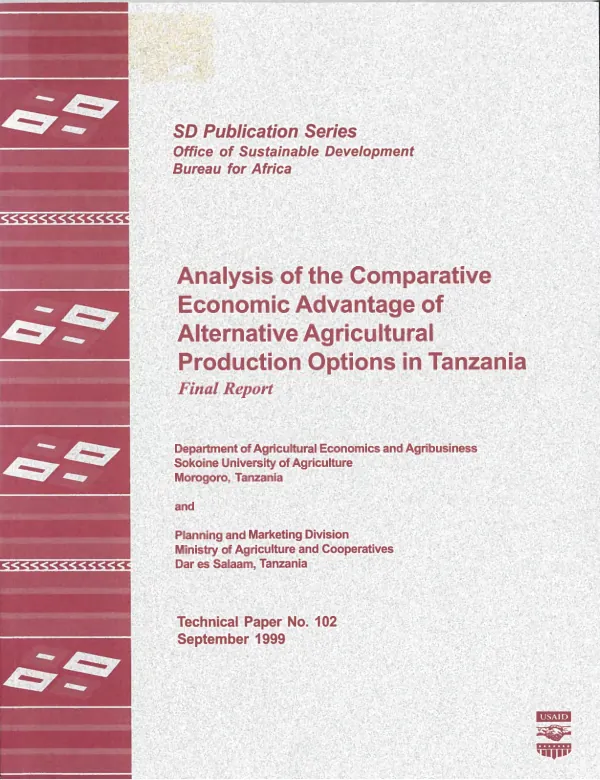
Analysis of the comparative economic advantage of alternative agricultural production options in Tanzania
Sign inSOKOINE UNIVERSITY OF AGRICULTURE. DEPT. OF AGRICULTURAL ECONOMICS AND AGRIBUSINESS
Analysis of the comparative economic advantage of alternative agricultural production options in Tanzania
In a recent series of trade studies in eastern and southern Africa, the Policy Analysis Matrix (PAM) methodology was used to determine Tanzania"s comparative economic advantage (CEA) in the production of major cash and food crops (coffee, cotton, maize, and rice) in different farming systems and agro-ecological zones.
1999
Sign in to readA free account is required to download.
Abstract
The methodology was also used to assess the effect of government intervention policies on the production of these crops. The domestic resource cost (DRC) results derived from the PAM indicate a CEA of producing cotton in the Western Cotton Growing Area (WCGA), coffee in the southern zone, and rice in Morogoro. The production of maize in Morogoro and arabica coffee in the northern zone indicate a comparative economic disadvantage, implying inefficient use of resources to produce the commodities in these areas. Low yields are probably among the important factors creating this comparative disadvantage. The measures of distortion (NPC [nominal protection coefficient] and EPC [effective protection coefficient]) suggest that food crops were protected by government pricing policies. Cash crops (with the exception of coffee in the northern zone) were taxed. Government protection policy on food crops may be desirable due to some social and political objectives such as food security or poverty alleviation, which cannot be easily qualified. Recommendations emanating from this study are as follows: (1) If farmers are to increase resource allocations to a particular crop, more effective measures are needed to improve production constraints and, consequently, farm gross margins, e.g., policy measures to revive the production of Northern Highlands coffee. (2) Given the potential for high-quality output, measures are needed to improve quality, which has a high demand on the world market. (3) Policy measures are necessary to improve processing quality capacity. (4) Research should be conducted on the role of competing products, e.g., products that compete with cotton and their effect on the domestic textile milling industry. Includes PAM tables, a brief discussion of factors influencing DRC determination, summary descriptions of the agro-ecological zones and farming systems of mainland Tanzania, and references. (Author abstract, modified)
Related documents