RICE UNIVERSITY
Analysis of the saving behavior of a group of Colombian artisan entrepreneurs
Explores how to improve the distribution of income and the quality of life of one subgroup of low-income workers in Colombia.
Huddle, D. L. · 1970
Sign in to readA free account is required to download.
Abstract
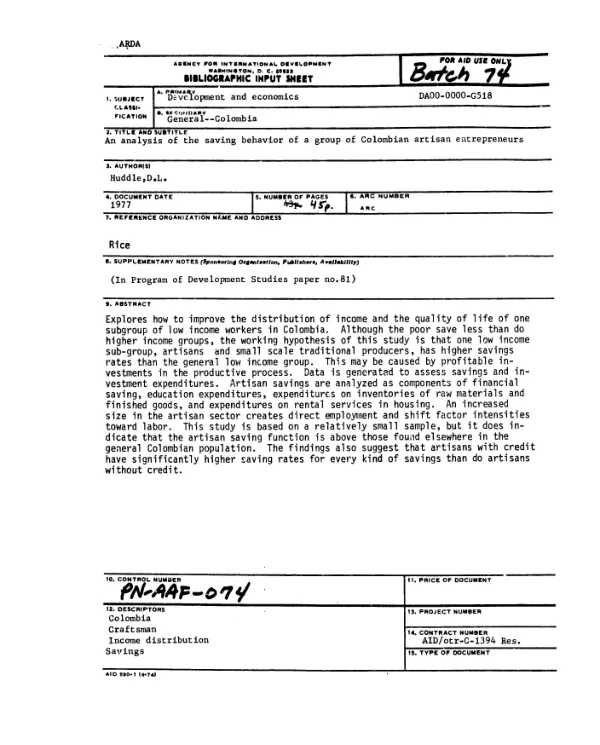
Although the poor save less than do higher income groups, the working hypothesis of this study is that one low-income subgroup, artisans and small-scale traditional producers, has higher savings rates than the general low-income group. This may be caused by profitable investments in the productive process. Data is generated to assess savings and investment expenditures. Artisan savings are analyzed as components of financial saving, education expenditures, expenditures on inventories of raw materials and finished goods, and expenditures on rental services in housing. An increased size in the artisan sector creates direct employment and shift factor intensities toward labor. This study is based on a relatively small sample, but it does indicate that the artisan saving function is above those found elsewhere in the general Colombian population. The findings also suggest that artisans with credit have significantly higher savings rates for every kind of savings than do artisans without credit.
Connected topics
Related documents