USAID. BUR. FOR LATIN AMERICA AND THE CARIBBEAN. OFC. OF DEVELOPMENT RESOURCES
Andean peace scholarship program
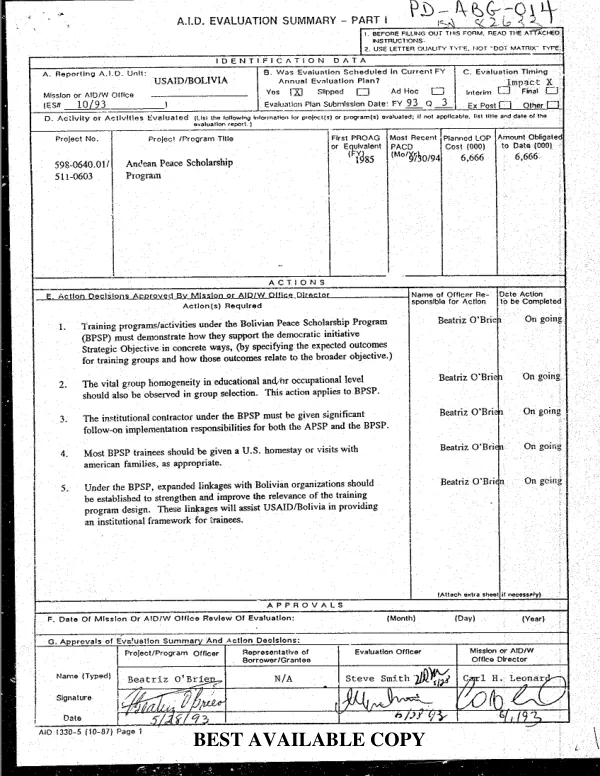
Summarizes final evaluation (PD-ABF-830) of a project (1987-92) to provide U.S.
1993
Sign in to readA free account is required to download.
Abstract
peace scholarships to economically and socially disadvantaged Bolivians. The evaluation was based on a survey of 174 of the project"s 432 trainees and focused on the impact of U.S. training on returnees" performance in the workplace, participation in community or volunteer activities, and role as multiplier agents, and well as the quality and relevance of follow-on activities. Trainees generally expressed high satisfaction with the training, and all but a few are currently employed. Most found the training either "useful" or "very useful" in their current job (84%), for learning new practical and technical skills (77%), and for future career advancement (80%), three proxy indicators of job impact. Many were able to identify specific examples of the benefits to their job performance, and a large majority reported increased job satisfaction and greater responsibilities on the job; about half reported increased income as well. However, a significant minority expressed reservations about the direct applicability of the training they had received, 40% reporting that they use the training only "some" or "not at all" on the job. Presumably, this indicates that there are obstacles to the application of their new skills. About 77% of all returnees are actively involved in volunteer activities. Some were already active in volunteer activities and community affairs before the training; of those, nearly 69% felt that they are more active now. The range of activities is wide, including educational projects, civic or union activities, charity concerns, cultural programs, and community improvement. Trainees are acting as multipliers both in the workplace and in the community. It is estimated that returnees have shared their training with up to 100,000 Bolivians through contacts with workers and in the community. Nearly 90% assert that the training has made them more effective leaders at work and in community activities, and large majorities also report that their status has risen in the eyes of employers, co-workers, family, and the community, and that their own self-esteem has been boosted. Follow-on activities have supported trainees in wide-ranging efforts to share the results of their training or other areas of expertise. Seminars for professionals, a national youth congress, an urban nutritional fair for poor neighborhoods, and workplace seminars in the public sector have taken place. However, the participation of some of the more isolated returnees, especially the most economically disadvantaged, has been limited due to procedural difficulties with follow-on activities. The survey also found that perceived racial discrimination was the most negative aspect of the U.S. training. Six groups of returnees who were especially effective in applying their training were examined to isolate factors which appear to have enhanced their effectiveness. Success factors appear to include: (1) the identification of appropriately trained and motivated candidates; (2) ample communication with trainees" employers before training; and (3) training which is well suited to the trainee"s backgrounds and directly applicable to their jobs or volunteer activities. The Mission should keep these factors in mind in the successor project, the Bolivia Peace Scholarship Program. It should also observe the principle of group homogeneity in educational level in group selection. Additional recommendations for the follow-on project are included.
Related documents
Documents in this collection
 1991
1991USAID DEC
Assessment of the impact of CLASP training among selected groups of CLASP trainees in Guatemala and a review and assessment of in-country follow-on efforts in Guatemala : volume II
Open record 1991
1991USAID DEC