USAID. MISSION TO ECUADOR
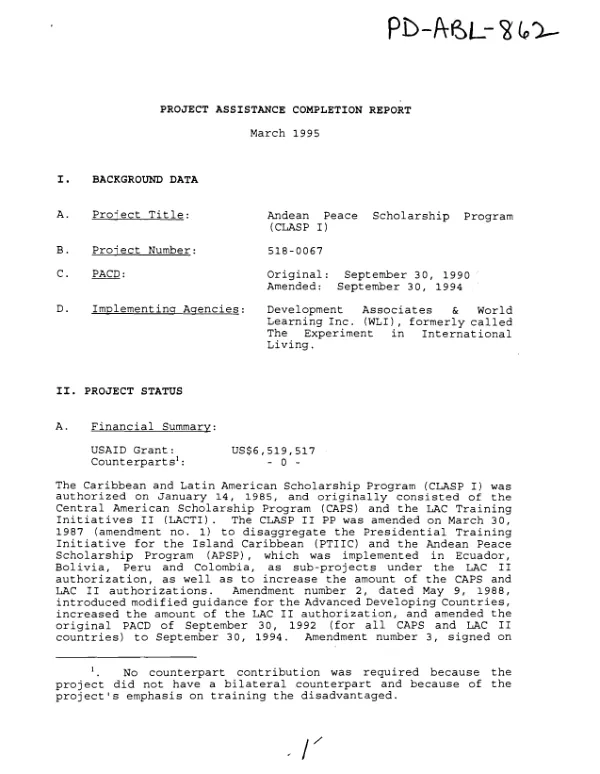
Project assistance completion report : Andean peace scholarship program (CLASP I)
PACR of the Ecuador subproject (9/90-9/94) of the Andean Peace Scholarship Program (APSP), itself a component of the Caribbean and Latin American Scholarship Program (CLASP) to counter Soviet, Bloc, and Cuban training activity by increasing the number of U.S.-trained individuals from the socially and economically disadvantaged class of Latin American and Caribbean countries.
1995
Sign in to readA free account is required to download.
Abstract
The APSP/Ecuador project met or exceeded all of the quantitative requirements for the CLASP program. A total of 413 Ecuadorians (3 more than the modified target) received APSP training, including 90 long-term participants and 323 short-term participants. Of the long-term participants, 48 received Master's degrees, 22 participated in non-degree graduate study programs, and 20 were enrolled in undergraduate non-degree programs. Of the overall total of 413 participants, 76% were disadvantaged and 44% were women (versus targets of 40% and 70%, respectively). Every participant was a leader or a potential leader, and 14% attended programs at Historically Black Colleges and Universities (versus a target of 10%). All of Ecuador's 21 provinces were represented in APSP selection. An APSP Alumni Association was created for follow-on activities, but was discontinued after funding ceased. Trainees benefitted both professionally and personally, and applied the skills and knowledge acquired in training. The program generally improved the participants' status in their jobs and communities, increased their leadership capacity, and supported their development as change agents. Numerous lessons learned and general recommendations are provided, including the following. (1) Delays in recruiting participants can result in high start-up costs if the training contractor is fully staffed from the beginning. (2) Many more people would have been trained if host or third country training had been permitted. Local training would also have made the training more effective. (3) Congressionally mandated targets for disadvantaged participants and women limited identification of target groups. The likelihood of meeting such targets should be assessed; requiring counterparts to nominate women in a male-dominated field, for example, is an unsuccessful strategy. (4) Training impact is likely to be greater if trainees are targeted within identified subject areas. It is also important to ensure a pool of quality candidates before repeating programs for the same target group, and to define the notion of critical mass. (5) Whenever possible, both the institution and the participant should commit to repaying the cost of the scholarship if the degree program is not completed. (6) The greater the homogeneity of participants' educational background and needs, the more successful the program. (7) Institutionally focused recruitment was more effective than open recruitment through, for example, newspapers. (8) Both long- and short-term candidates should be interviewed. (9) The training institution should receive as much background information on the participant as possible. (10) When recruiting at the grassroots level, it is important to verify a candidate's possession of basic identity documents. (11) Minimal English proficiency standards must be established for long-term U.S. trainees. (12) Predeparture orientation is more effective when given to groups rather than to individuals. (13) It is preferable to finance a small number of degree programs than a large number of non-degree programs. (14) It may be preferable to substitute continuing education workshops for a participant alumni association.
Related documents