USAID DEC
Annual Narrative Report: Year 1 of the Strengthening the Capacity of Indigenous Organizations in the Amazon project
Sign inPACT
Annual Narrative Report: Year 1 of the Strengthening the Capacity of Indigenous Organizations in the Amazon project
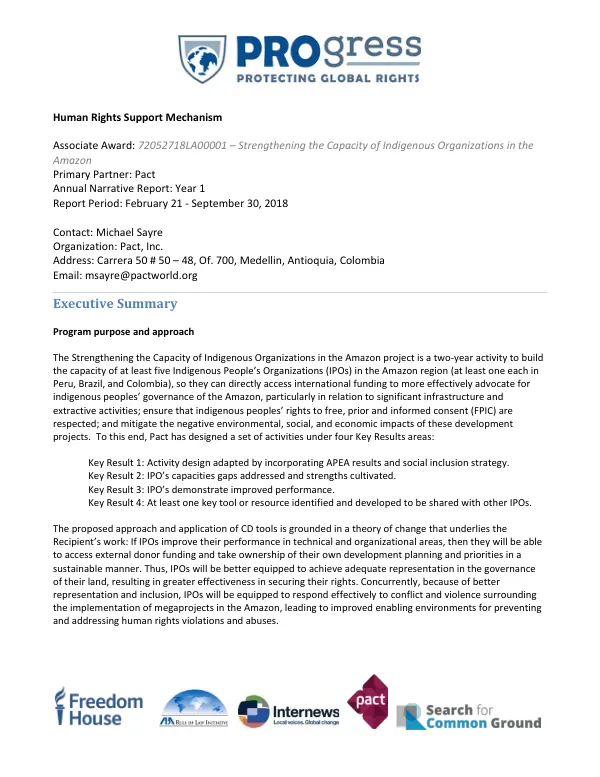
The Strengthening the Capacity of Indigenous Organizations in the Amazon project is a two-year activity designed to build the capacity of at least five Indigenous People's Organizations (IPOs) in the Amazon region.
2018 · 9 pages
Sign in to readA free account is required to download.
Abstract
The project aims to enable IPOs to directly access international funding, advocate for indigenous peoples' governance of the Amazon, and ensure that indigenous peoples' rights to free, prior, and informed consent (FPIC) are respected. To achieve this, Pact has designed a set of activities under four Key Results areas: Activity design adapted by incorporating APEA results and social inclusion strategy, IPO's capacities gaps addressed and strengths cultivated, IPO's demonstrate improved performance, and at least one key tool or resource identified and developed to be shared with other IPOs. The project's approach is grounded in a theory of change that underlies Pact's work: If IPOs improve their performance in technical and organizational areas, then they will be able to access external donor funding and take ownership of their own development planning and priorities in a sustainable manner. This, in turn, will enable IPOs to achieve adequate representation in the governance of their land, resulting in greater effectiveness in securing their rights. Concurrently, better representation and inclusion will equip IPOs to respond effectively to conflict and violence surrounding the implementation of megaprojects in the Amazon, leading to improved enabling environments for preventing and addressing human rights violations and abuses. During the first year of the project, which covered the period from February to September 2018, Pact adapted proposed approaches based on initial findings from Applied Political Economy Analyses (APEAs) conducted in Peru and Colombia. The project identified key collaborators for the implementation of capacity development activities in the three priority countries and continued engagement with key stakeholders in government, local non-governmental organizations (NGOs), and indigenous peoples' organizations. The project's Activity Manager was onboarded in April 2018, and the project initiated start-up and planning activities, including a project kick-off workshop in Peru in May 2018. Between August and October 2018, APEAs were conducted in Peru and Colombia, which led to a reassessment of the initial proposed approach to work with individual consultants or Capacity Development Advisers to provide capacity development support to IPOs in the three countries. The findings suggested the need to work with local NGOs, referred to as Capacity Development Organizations (CDOs), who have a presence in the regions where IPOs are located and with previous experience providing capacity development support to IPOs in those territories. The APEAs provided information on the IPO landscape and operating context in each country, contributing to a clearer understanding of the types of IPOs that the activity would seek to engage. In September 2018, Pact initiated the subaward application process for identifying one CDO each in Brazil, Colombia, and Peru. The application process for the CDOs will finalize on October 15th, 2018, with subawards to CDOs to be executed by November 15th, 2018. The recruitment process for the Brazil APEA consultant also concluded in September, with the completion date for the Brazil APEA set for November 9th, 2018. Finally, the recruitment of the Social Inclusion consultant began in September, with the consultant expected to begin their engagement the first week of November. The project has faced several challenges, including managing expectations of indigenous peoples' organizations, low quality of applicants for the Social Inclusion consultancy, and engaging with FUNAI, a key government agency in Brazil. To mitigate these challenges, the project will emphasize the point that meetings with IPOs are introductory and not fundraising opportunities, work closely with selected local NGOs to reach out to IPOs that have been previously identified and vetted, and utilize networks and platforms of professionals working on social inclusion and related topics to attract consultants with the requisite experience. Establishing a relationship with FUNAI is a critical objective of the Brazil APEA, and the consultant who has been selected to lead the APEA has existing relationships with officials and technical staff at the agency.