USAID DEC
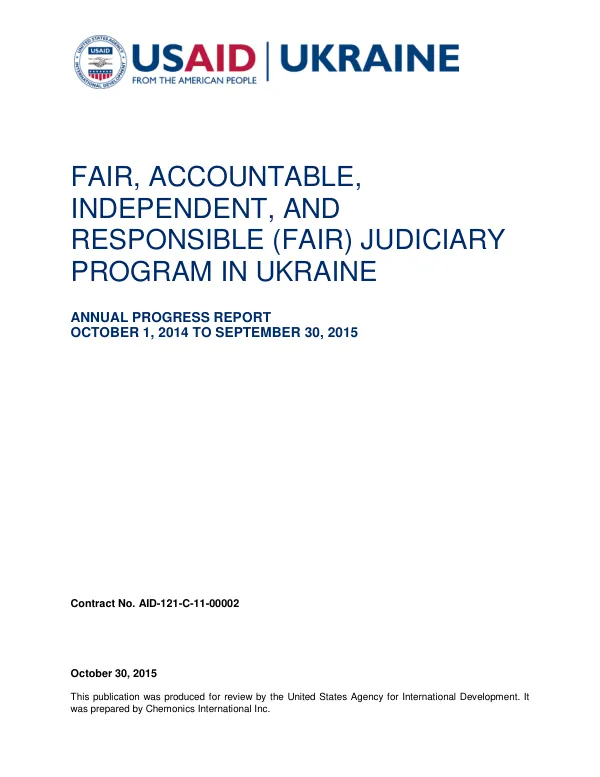
Annual Progress Report: FAIR, Accountable, Independent, and Responsible (FAIR) Judiciary Program in Ukraine
Sign inCHEMONICS
Annual Progress Report: FAIR, Accountable, Independent, and Responsible (FAIR) Judiciary Program in Ukraine
The Fair, Accountable, Independent, and Responsible (FAIR) Judiciary Program in Ukraine was a four-year initiative aimed at supporting legislative, regulatory, and institutional reforms in Ukraine's judicial institutions.
2015 · 103 pages
Sign in to readA free account is required to download.
Abstract
The program was implemented from October 1, 2014, to September 30, 2015, with funding from the United States Agency for International Development (USAID). The primary objective of the program was to build the foundation necessary for a more accountable and independent judiciary in Ukraine. Despite the challenging operating environment, FAIR continued to make progress across project activities. The program's primary objective required USAID's committed assistance, and the project's achievements to date continued to advance this objective in the face of ongoing challenges. The Ukrainian judiciary has responded poorly throughout the crisis period and remains subject to weak judicial leadership and institutions with limited capacity to fully defend judicial independence and uphold human rights. However, President Petro Poroshenko's leadership has led to progress in judicial reform, especially on the development of proposed amendments to the Constitution and adoption of amendments to the Law on the Judiciary and Status of Judges. Building on the continued public demand for judicial reform, FAIR provided critical support to the judiciary, government, and civil society in Year 4 in the following key areas: Legal Framework Reform, Judicial Selection and Evaluation, Judicial Ethics, and Engaging Civil Society. In the area of Legal Framework Reform, the Constitutional Commission, created by the President of Ukraine on March 3, 2015, worked to develop amendments to the Constitution of Ukraine in the human rights and justice sector area. FAIR provided technical support to the Constitutional Commission, involving US experts, supporting public discussions, and working to raise public awareness about the constitutional reform. In the area of Judicial Selection and Evaluation, FAIR continued its support for an objective and merit-based system for judicial selection. With FAIR's guidance and assistance, the High Qualifications Commission of Judges (HQC) conducted training of test writers to prepare future judicial selection tests. FAIR also supported the HQC in the development of new regulations governing the evaluation of sitting judges. In the area of Judicial Ethics, Ukraine's judiciary took meaningful steps toward improving ethical practices by drafting commentary to the Code of Judicial Ethics for the Council of Judges (COJ) and launching the first online course for judges on the Code. FAIR also supported the development of more than 900 civil society recommendations to courts to improve court functions. The program's achievements in Year 4 include providing assistance to 588 courts covering every region of Ukraine, supporting 22 government justice sector institutions, and targeting programming to 46 civil society organizations. FAIR also promoted eleven amendments to Ukrainian legislation to enhance judicial independence, trained 2,090 judges and judicial personnel, and developed 12 new legal courses and curricula. The report that follows describes the program's successes in greater detail, providing information on key achievements, progress made in meeting performance targets, budget execution, project management, and donor coordination over the past year.
Related documents