USAID DEC
Annual Progress Report: Georgian Hazelnut Improvement Project (G-HIP) Activity in Georgia
Sign inCNFA, INC.
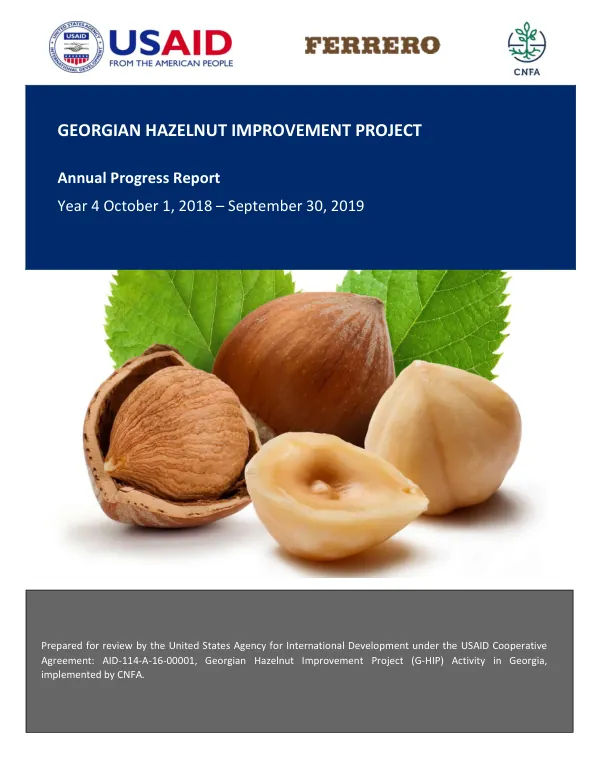
Annual Progress Report: Georgian Hazelnut Improvement Project (G-HIP) Activity in Georgia
The Georgian Hazelnut Improvement Project (G-HIP) Activity in Georgia, implemented by CNFA, aimed to improve the competitiveness and productivity of the hazelnut industry in Georgia.
2019 · 32 pages
Sign in to readA free account is required to download.
Abstract
The project focused on three key components: Association Development, Increased Productivity and Competitiveness, Postharvest Handling, and Infrastructure Development and Marketing. During Project Year 4, G-HIP strengthened the Georgian Hazelnut Growers Association's (GHGA) internal capacity through Component 1. GHGA's organizational capacity was built through training and capacity-building programs, which enabled the association to effectively manage its operations and make informed decisions. GHGA staff capacity was also enhanced through training programs, which improved their skills and knowledge in areas such as financial management, marketing, and communication. Component 2, Increased Productivity and Competitiveness, Postharvest Handling, focused on improving the productivity and competitiveness of hazelnut farmers. Productivity and competitiveness were enhanced through training programs on best practices in hazelnut cultivation, postharvest handling, and marketing. The project also facilitated the establishment of demonstration plots, which showcased the benefits of adopting improved agricultural practices. As a result, hazelnut yields increased, and farmers were able to improve their income. Component 3, Infrastructure Development and Marketing, aimed to develop the marketing infrastructure for hazelnuts in Georgia. The project facilitated the establishment of market infrastructure, including storage facilities and transportation networks, which improved the efficiency of hazelnut supply chains. Marketing and communications activities were also conducted to promote Georgian hazelnuts both domestically and internationally. The project achieved significant milestones during Project Year 4. GHGA's organizational capacity was strengthened, and the association was able to effectively manage its operations. Hazelnut yields increased, and farmers were able to improve their income. The project also facilitated the establishment of market infrastructure, which improved the efficiency of hazelnut supply chains. Key indicators of the project's success include the increase in hazelnut yields, the improvement in farmers' income, and the development of market infrastructure. The project's achievements are reflected in the outputs and outcomes reported in the tables and indicators provided in the report. The project's success is a testament to the effective implementation of the G-HIP Activity in Georgia and the commitment of the project team to achieving the project's goals. The project's financial and expenditure summary indicates that the project was implemented within budget and that the funds were utilized effectively to achieve the project's objectives. The project's performance measurement plan and monitoring and evaluation activities ensured that the project was on track to meet its goals and that any deviations from the plan were addressed promptly. Overall, the G-HIP Activity in Georgia made significant progress during Project Year 4, achieving its goals and objectives. The project's success is a testament to the effective implementation of the project and the commitment of the project team to achieving the project's goals.
Related documents