CNFA, INC.
Sector Selection and Value Chain Analysis
The Georgian agricultural sector continues to develop, with significant growth in recent years.
2019 · 112 pages
Sign in to readA free account is required to download.
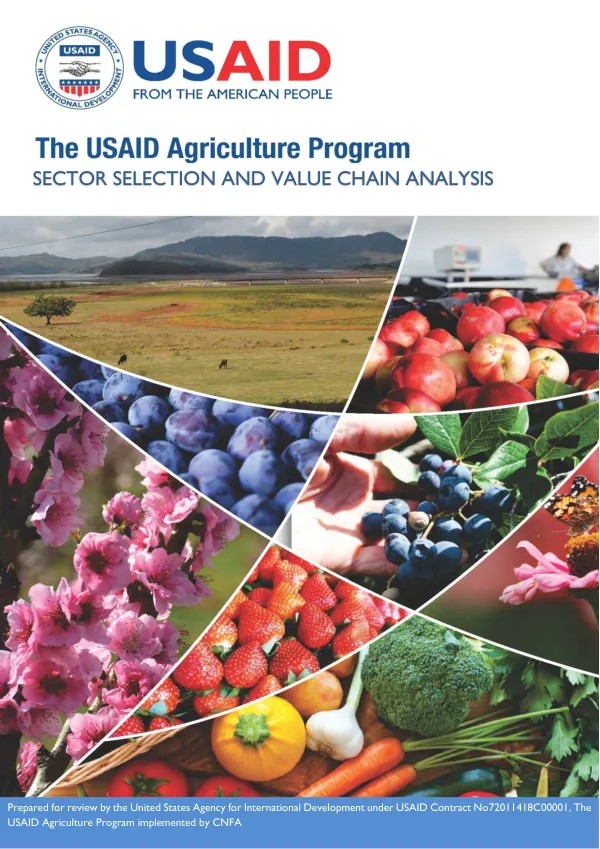
Abstract
Farms are small, but there are constraints in access to inputs, machinery, and equipment. Despite these challenges, farmers and investors are discovering ways to develop businesses in agriculture, leveraging opportunities such as good climatic conditions, high local prices, and a growing tourism market. Georgia is experiencing a positive agricultural production growth trend, with drivers including farm consolidation, improved farmer capacity, state investment support, and increased irrigation. The area of irrigated land has expanded from 45,000 hectares to 120,000 hectares, and the area of drained land has increased from 14,000 hectares to 36,900 hectares. Donor programs, state participation in agriculture promotion, and investments from other sectors are also contributing to growth. The USAID Agriculture Program aims to identify priority value chains, identify gaps in the selected chains, and develop value-chain action plans to achieve improvements in the selected value chains. A competitiveness and product analysis was conducted for a wide range of products, which were then grouped based on value-chain commonalities in storage, investment, and marketing. Berries ranked second as a group, with three berries (raspberries, blackberries, blueberries) among the top ten individual products. Berries are profitable on small land plots, offer labor opportunities, have high value-adding potential, and enjoy increased consumption patterns in domestic and export markets. Program interventions will be directed all along the value-chain from inputs to marketing, with a particular focus on post-harvest handling for fresh and processing and marketing for frozen berries. Culinary Herbs scored highest as a group and second highest as an individual product, demonstrating competitiveness, strong domestic market potential, labor opportunities, and significant value-adding potential. Program interventions will be directed all along the value-chain with a particular focus on improved production practices, post-harvest handling and packaging of fresh products, and improved marketing linkages. Stone Fruits, including peaches and nectarines, demonstrate potential in both domestic and export markets. The focus will be on quality improvements in production and post-harvest handling, with significant attention to strengthening the cold chain and introducing quality standards for improved market access. Perishable Vegetables, including tomatoes and cucumbers, have a high and growing production value and offer strong opportunities for import substitution and season extension. The focus will be on improved production practices, access to inputs and extension, and disseminating these production practices to large numbers of producers. Apples offer a significant cluster opportunity in Shida Kartli, with the Agricultural Project Management Agency's (APMA) Plant the Future Program having invested in new modern, intensive orchards. Post-harvest technical assistance and investments in post-harvest infrastructure will be provided to enhance these production investments. Table Grapes are identified as a small sector in Georgia, but with potential in both the export and domestic markets. This sector will be treated as a pilot, selecting key, replicable activities for support and investment, to nurture an emerging high potential sector that could have a tremendous impact on the rural economy. Citrus (Mandarins) offer a cluster opportunity historically grown in Adjara and receiving significant attention from the regional Ministry of Agriculture. To enhance government investments in production, the USAID Agriculture Program will provide post-harvest technical assistance and support investments in post-harvest infrastructure.