USAID DEC
Annual Progress Report: Georgian Hazelnut Improvement Project (G-HIP) Activity in Georgia
Sign inCNFA, INC.
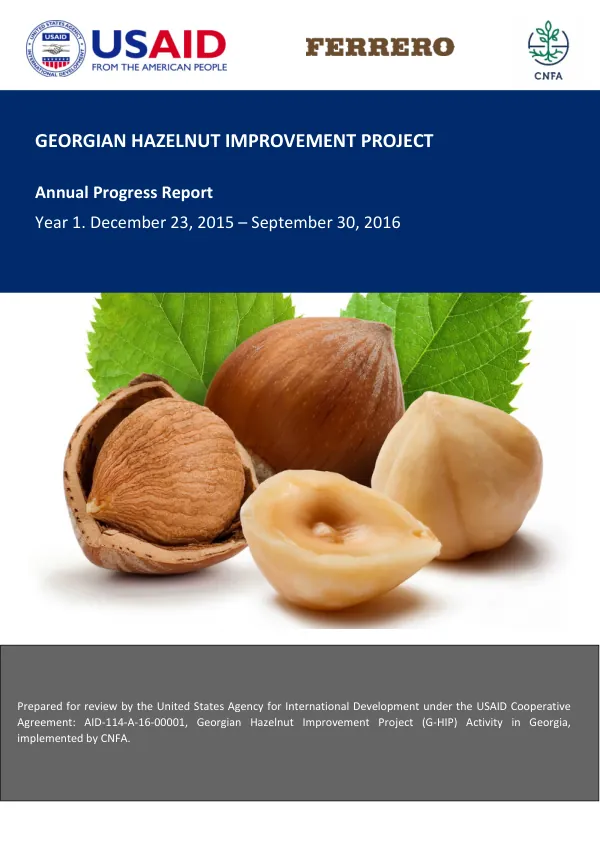
Annual Progress Report: Georgian Hazelnut Improvement Project (G-HIP) Activity in Georgia
The Georgian Hazelnut Improvement Project (G-HIP) Activity in Georgia was implemented by CNFA under the USAID Cooperative Agreement AID-114-A-16-00001.
2016 · 52 pages
Sign in to readA free account is required to download.
Abstract
The project aimed to improve the productivity and competitiveness of the hazelnut sector in Georgia. Key stakeholders, including Ferrero International, recognized the region's potential for increased hazelnut production, with opportunities for improving existing plantations and expanding production areas. Component 1 of the project focused on association development, with a primary goal of strengthening the Georgian Hazelnut Growers Association (GHGA). GHGA staff capacity building and organizational capacity building were key objectives, with the establishment of a Temporary Executive Committee (TEC) to oversee project implementation. The TEC structure is outlined in Figure 2, with a clear division of responsibilities among committee members. Component 2 of the project focused on increasing productivity and competitiveness, as well as postharvest handling. Productivity and competitiveness were improved through the implementation of best practices in hazelnut cultivation, while postharvest handling was enhanced through the development of efficient husking, drying, and storage facilities. Extension activities were also conducted to promote the adoption of improved practices among hazelnut growers. Figure 5 provides a summary of Component 2's outputs and status, highlighting the progress made in these areas. Component 3 of the project focused on infrastructure development and marketing. Promoting market infrastructure was a key objective, with the aim of improving access to markets for hazelnut growers. Marketing and communications activities were also conducted to promote the Georgian hazelnut sector and increase demand for hazelnuts. Figure 7 provides a summary of Component 3's outputs and status, highlighting the progress made in these areas. The project made significant progress in its first year, with key milestones achieved in each component. GHGA staff capacity building and organizational capacity building were completed, with the establishment of a functional TEC. Productivity and competitiveness were improved through the implementation of best practices in hazelnut cultivation, while postharvest handling was enhanced through the development of efficient husking, drying, and storage facilities. Infrastructure development and marketing activities were also conducted, with the aim of improving access to markets for hazelnut growers. The project's performance was monitored and evaluated through a range of indicators, including those related to productivity, competitiveness, and market access. Figure 9 provides a summary of the Feed the Future (FTF) indicators, highlighting the progress made in these areas. Figure 10 and Figure 11 provide summaries of the gender and PPR indicators, respectively, while Figure 12 provides a summary of custom indicators. The project's financial and expenditure summary is provided in Annex 1, with a detailed breakdown of expenditures by component and activity.