USAID DEC
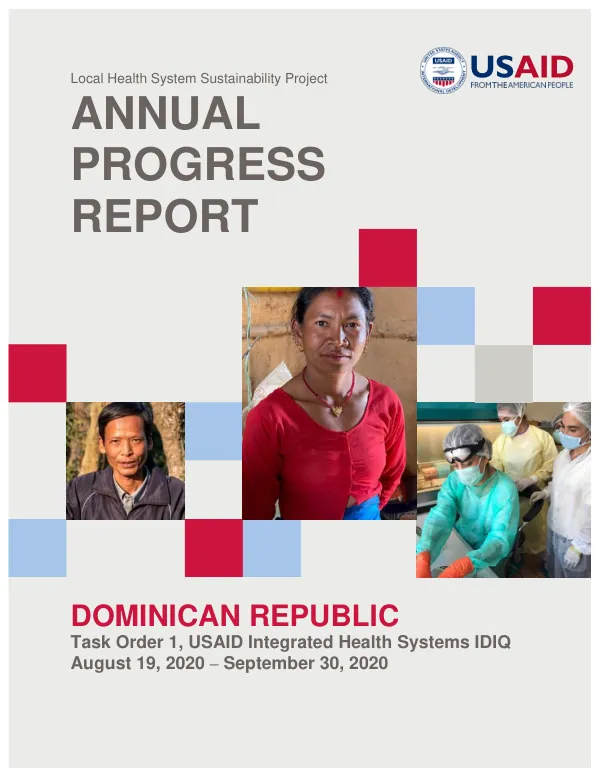
Annual Progress Report: Local Health System Sustainability Project (LHSS) Dominican Republic Activity
Sign inABT ASSOCIATES
Annual Progress Report: Local Health System Sustainability Project (LHSS) Dominican Republic Activity
The Local Health System Sustainability Project (LHSS) in the Dominican Republic aims to strengthen the Government of the Dominican Republic's (GODR) capacity to sustainably manage quality HIV prevention and services.
2020 · 18 pages
Sign in to readA free account is required to download.
Abstract
The one-year activity will work with the GODR to advance greater local ownership of HIV prevention and control, operationalize and supervise global standards of clinical care at the facility and community levels, and ensure focus clients have access to quality HIV services. The activity will achieve this goal through two objectives: 1) strengthening governance and management of HIV service delivery, including at the community level, and 2) strengthening service delivery capacity to improve quality of HIV care at the facility and community levels. The LHSS project will contribute to the overarching goal of USAID's Country Development Cooperation Strategy of improving citizen security to promote economic growth and Development Objective 3 of advancing an AIDS-free generation. The activity aligns with the cross-cutting themes of transparency and accountability and addressing the needs of marginalized communities, including women, focus clients, the LGBTQ community, and people with disabilities. LHSS activities will also support USAID goals to help priority countries achieve high-performing health systems that offer quality care that is accountable, affordable, accessible, and reliable. The COVID-19 response activity in the DR will support the successful placement and operationalization of USAID's donation of 50 mechanical ventilators to the GODR and strengthen efforts to improve immediate intensive care case management capacities of the national health service, Servicio Nacional de Salud (SNS), in addressing the COVID-19 epidemic. The activity will partner with 13 hospitals to provide rapid technical assistance in the review and validation of comprehensive clinical protocols and SOPs related to identification of severe and critical COVID-19 cases, approaches to triage, and critical care case management. The COVID-19 activity centers on two overarching objectives: 1) developing and validating clinical protocols, SOPs, and ICU-level case management techniques for COVID-19 interventions, with particular attention on the use of mechanical ventilators, and 2) training hospital-based ICU-teams of various cadres on the COVID-19 clinical protocols and algorithms, SOPs, and critical care case management techniques. The activity's theory of change maintains that if a higher quality of HIV clinical care is provided for focus clients at the facility and community levels through improved supportive supervision and staffing, then access to high-quality and appropriate HIV services will increase. The LHSS project will work with the GODR to strengthen governance and management of HIV service delivery, including at the community level, and strengthen service delivery capacity to improve quality of HIV care at the facility and community levels. The project will also support the successful placement and operationalization of USAID's donation of 50 mechanical ventilators to the GODR and strengthen efforts to improve immediate intensive care case management capacities of the national health service, SNS, in addressing the COVID-19 epidemic. The LHSS project will achieve its objectives through a multi-sectoral approach emphasizing local capacity development. The project will partner with 13 hospitals to provide rapid technical assistance in the review and validation of comprehensive clinical protocols and SOPs related to identification of severe and critical COVID-19 cases, approaches to triage, and critical care case management. The project will also train health professional teams in partner hospitals on materials and SOPs for critical care COVID-19 case management. The LHSS project will contribute to the improvement of citizen security in the Dominican Republic by strengthening the health system's capacity to provide quality HIV services and responding to the COVID-19 epidemic. The project will also support the achievement of the UNAIDS 95/95/95 targets by 2030 and advance an AIDS-free generation.