USAID DEC
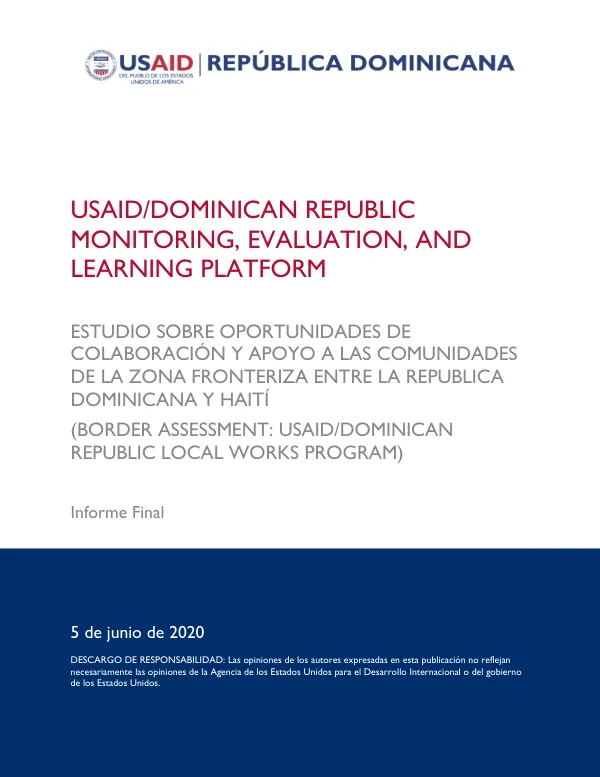
Final Report: Assessment of Opportunities for Support to Communities in the Border Zone between the Dominican Republic and Haiti
Sign inPANAGORA GROUP, INC.
Final Report: Assessment of Opportunities for Support to Communities in the Border Zone between the Dominican Republic and Haiti
The agricultural development initiative in the Dominican Republic's border region with Haiti began in 2018 with a focus on improving the lives of local communities.
2020 · 92 pages
Sign in to readA free account is required to download.
Abstract
The initiative was led by the USAID/Dominican Republic Monitoring, Evaluation, and Learning Platform, in collaboration with the Panagora Group. The study aimed to assess opportunities for support to communities in the border zone, with a particular emphasis on the sectors of health, education, water, and protection of the child. The study employed a mixed-methods approach, combining both qualitative and quantitative data collection and analysis methods. The research team conducted interviews with key stakeholders, including government officials, community leaders, and representatives from local organizations. The team also collected and analyzed data from various sources, including government reports, surveys, and focus group discussions. The study's findings highlighted several key challenges facing the communities in the border region. In the sector of health, the study found that the primary level of attention in health was poorly organized, with inadequate management of financial resources and limited participation of community members. The study also identified several problems in the provision of health services, including a lack of access to healthcare facilities and inadequate training of healthcare providers. In the sector of education, the study found that the organization of the education sector was inadequate, with limited access to educational services and inadequate management of financial resources. The study also identified several problems in the provision of educational services, including a lack of qualified teachers and inadequate infrastructure. The study's findings also highlighted several opportunities for support to communities in the border region. In the sector of water, the study found that the organization of the water sector was inadequate, with limited access to clean water and inadequate management of financial resources. The study also identified several opportunities for support, including the development of new water sources and the improvement of existing infrastructure. In the sector of protection of the child, the study found that the organization of the sector was inadequate, with limited access to protective services and inadequate management of financial resources. The study also identified several opportunities for support, including the development of new programs and services to protect children from violence and exploitation. The study's recommendations emphasized the need for improved coordination and collaboration among government agencies, local organizations, and community members. The study also recommended the development of new programs and services to address the specific needs of communities in the border region. The study's findings and recommendations provide valuable insights for policymakers, practitioners, and researchers working to improve the lives of communities in the Dominican Republic's border region with Haiti.