CENTER FOR EDUCATIONAL DEVELOPMENT
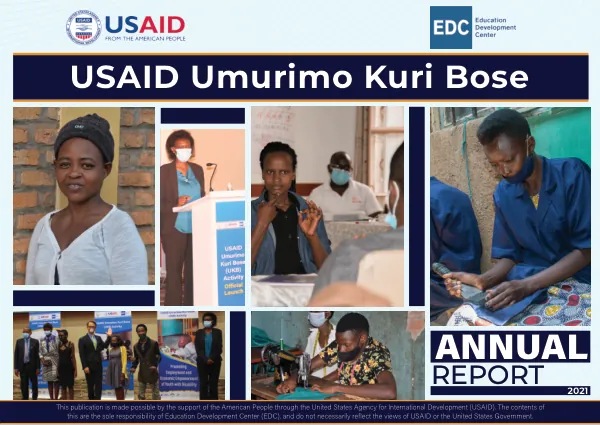
Annual Progress Report: USAID Umurimo Kuri Bose (UKB)
The USAID Umurimo Kuri Bose (UKB) program aims to foster a more inclusive workforce development system in Rwanda by increasing youth employability skills, empowerment, engagement, and equity, particularly for youth with disabilities.
2021 · 48 pages
Sign in to readA free account is required to download.
Abstract
The program serves 1,560 youth, focusing on those with disabilities, in 12 districts across Rwanda. A subset of 360 youth without disabilities is also included to promote an inclusive learning environment and address stigma against people with disabilities. UKB's objectives are achieved through various interventions, including training programs, infrastructure development, and market linkage facilitation. The program conducts trainings for new trainers from Disability Persons' Organizations (DPOs) and Implementing Partners (IPs), as well as refresher trainings in Work Ready Now/Be Your Own Boss (WRN/BYOB). EDC and AKA also trained UKB consortium partners, district officials, and private sector members on EDC's Local Labor Market Assessment (LLMA) approach. In its first year of implementation, UKB launched and conducted activities in 12 districts across Rwanda, enrolling a total of 1,560 youth, 1,200 with disabilities, and 360 without disabilities in two separate cohorts. The program adapted and piloted AKA's literacy and numeracy assessment, EDC's Work Ready Now Credential test, and the WORQ tool to youth with disabilities. This adaptation and pilot process consolidated the collaborative and consultative nature of UKB's implementation. EDC led a Master Trainer of Trainer's training on the newly developed Resiliency and Human Rights module, which covers various topics designed to have youth gain a better understanding of their rights, grow in their agency and self-advocacy, and learn the value and importance of a strong social network. The module includes relevant workplace scenarios to draw linkages for youth between the module content and workplace learning. Throughout the year, UKB implemented various activities, including community awareness-raising activities, training of 29 companies and 7 Technical Vocational Education and Training (TVET) institutions on Disability Mainstreaming, and matching 138 youth with workplaces that were trained in disability mainstreaming. Despite significant movement restrictions due to the COVID-19 pandemic, UKB adapted and continued its activities, including a final Disability Mainstreaming Training, matching youth to workplaces, and placing the remaining Cohort 1 youth into Work-based Learning (WBL) or On-the-Job Training (OJT). In Q4, UKB partners began preparing for Cohort 2 youth, scheduled to begin training early in FY22. These preparations included conducting refresher trainings for WRN/BYOB and selection and enrollment of 820 Cohort 2 youth. The program also supported 379 vulnerable persons in benefiting from USG-assisted social services, conducted 9 community awareness-raising activities, and trained 29 companies and 7 TVET institutions on Disability Mainstreaming. Overall, the UKB program aims to create a more inclusive workforce development system in Rwanda, particularly for youth with disabilities, by increasing their employability skills, empowerment, engagement, and equity. The program's interventions, including training programs, infrastructure development, and market linkage facilitation, are designed to achieve this objective and promote an inclusive and enabling environment for youth with disabilities to access and succeed in employment.