USAID DEC
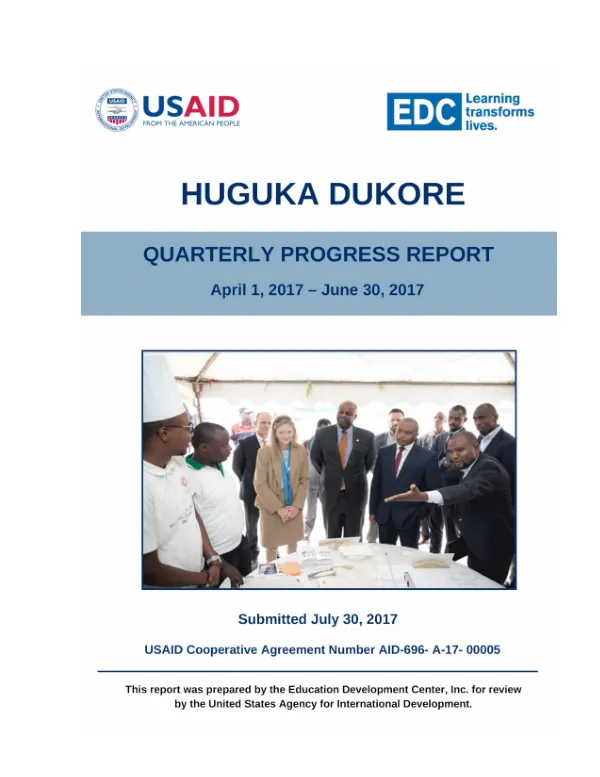
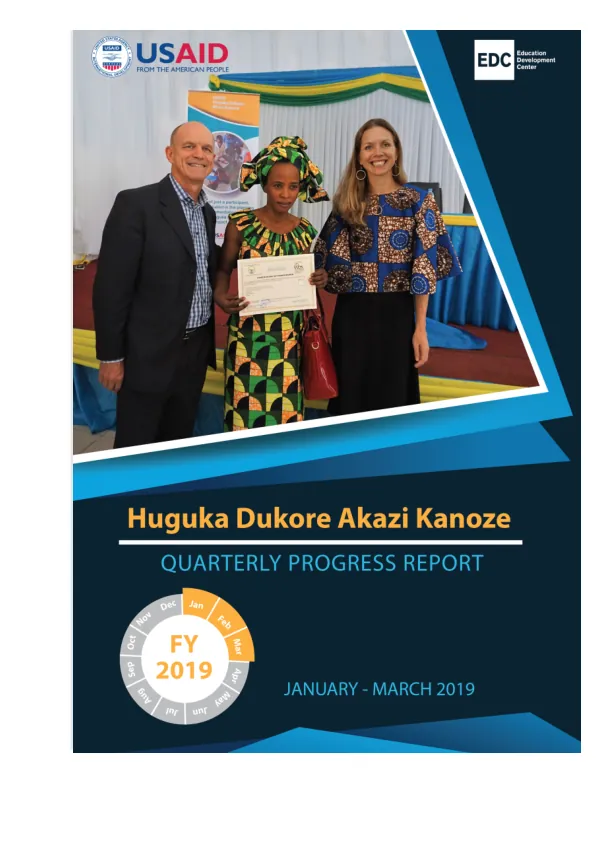
USAID Huguka Dukore Akazi Kanoze (HDAK) Quarterly Progress Report: January – March 2019
Sign inCATHOLIC RELIEF SERVICES ORGANIZATION
USAID Huguka Dukore Akazi Kanoze (HDAK) Quarterly Progress Report: January – March 2019
The Huguka Dukore Akazi Kanoze (HDAK) project is a 5-year youth employment project in Rwanda, funded by the United States Agency for International Development (USAID).
2019 · 41 pages
Sign in to readA free account is required to download.
Abstract
The project aims to provide 40,000 out-of-school youth with market-relevant employability skills through scaling up successful interventions across 25 districts countrywide. The project focuses on providing workforce readiness skills and employment services to vulnerable youth, promoting viable self-employment among vulnerable male and female youth, and improving the quality and coordination of workforce development delivery systems. In the second quarter of fiscal year 2019, the project achieved significant milestones. A total of 8,487 newly enrolled youth received market-relevant workforce readiness skills and employment services, bringing the total enrollment to 11,812 youth and the life of project total to 27,662 youth enrolled. The youth leadership and accompaniment program continued to expand, with 18 IPs oriented to the youth leadership program, resulting in 422 trained youth leaders across 15 districts. The project also facilitated access to financial services for 4,667 new youth who joined Savings and Internal Lending Communities (SILCs). A total of RWF 34,893,605 ($38,525) was saved by SILCs this quarter, bringing the cumulative savings total to RWF 87,766,944 ($96,901). Additionally, 217 youth accessed loans from formal Financial Service Providers (FSPs). The project strengthened its partnerships with workforce development stakeholders, participating in the Rwanda Polytechnic stakeholders retreat and reviewing TVET sub-sector priorities and plans. HDAK was selected to co-chair a new TVET task force on Youth Employment and School-To-Work Transition. The project also provided additional support to the Rwanda Technical Qualification Framework (RTQF) Level 2 TVET curriculum development effort, which will enable vulnerable youth to increase their technical and basic education skills and access a Level 3 certificate program. The project's progress is aligned with its intermediate results, which include increasing access to market-relevant workforce readiness skills and employment services for vulnerable youth, increasing viable self-employment among vulnerable male and female youth, and improving the quality and coordination of workforce development delivery systems. The project's achievements demonstrate its commitment to achieving its goals and improving the lives of vulnerable youth in Rwanda. The project's progress is also reflected in the data presented in the report. Table 1 shows a summary of achievements for FY19 Q2 and the life of project. Table 2 shows the Q2 enrollment summary, with 8,487 newly enrolled youth and a total of 11,812 youth enrolled. Table 3 shows the summary of youth with market linkages, with 4,667 new youth joining SILCs and 217 youth accessing loans from FSPs. The project's achievements and progress demonstrate its commitment to achieving its goals and improving the lives of vulnerable youth in Rwanda. The project's focus on workforce readiness skills and employment services, financial inclusion, and workforce development delivery systems is critical to achieving its goals and improving the lives of vulnerable youth in Rwanda.