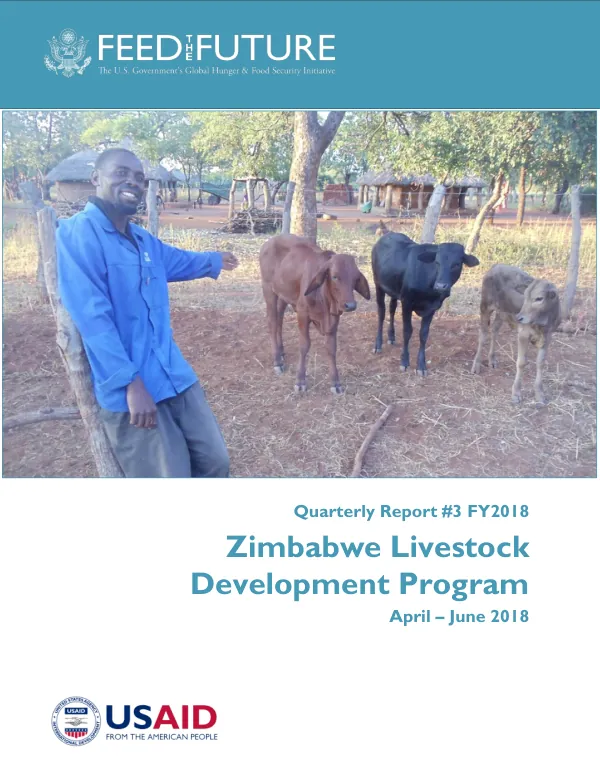
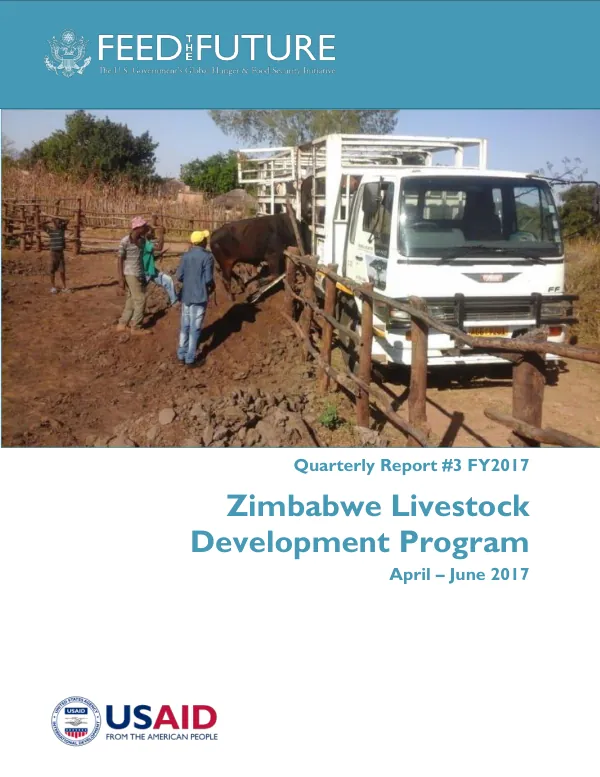
FINTRAC
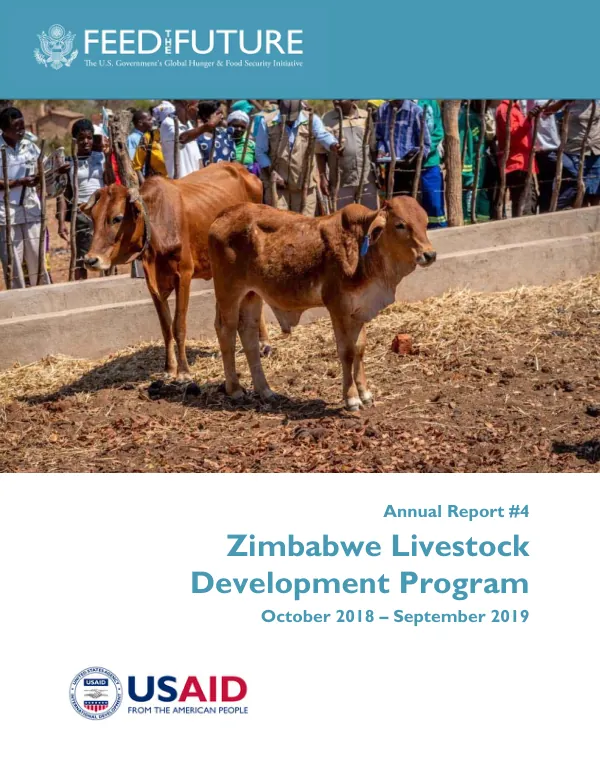
Annual Report #4: Feed the Future Zimbabwe Livestock Development Program
The Feed the Future Zimbabwe Livestock Development program is a market-driven initiative that aims to provide inclusive economic opportunities to smallholder farmers and other actors along the beef and dairy value chains.
2019 · 78 pages
Sign in to readA free account is required to download.
Abstract
The program is implemented by Fintrac Inc. in collaboration with local private companies, non-governmental organizations, and government departments involved in the beef and dairy value chains. The overall goal of the program is to sustainably increase the production, productivity, and incomes of smallholder farmers to enhance food security, nutrition, and poverty reduction, as well as build their resilience to climatic, economic, and social shocks. The program focuses on commercializing low-income and food-insecure households in agro-ecological regions III, IV, and V, with the potential to move from subsistence to small-scale commercial beef and dairy farmers. The program promotes and adopts good agricultural and animal husbandry practices, marketing, hygiene, and nutritional practices, and builds market linkages that generate income and increase farmers' overall resilience, food security, and improved nutritional and hygienic status. The program also aims to increase the institutional and organizational capacity of local organizations working with the program. During Fiscal Year 2019, the program worked with 4,073 beneficiaries who made $3.5 million in sales, a 51 percent increase from the previous year. Beef farmers made $1.32 million in sales, while dairy farmers made $2.18 million in sales. Female producers sold $1.1 million in both beef and dairy sales, or 31 percent of recorded sales during the review period, while youth beneficiaries sold $150,000 in both beef and dairy sales or 4 percent of recorded sales in the same period. Program interventions increased sales per household by 103 percent, from $423 in the previous year. The program's whole farm approach, the beef-dairy concept, and village aggregation model enabled beneficiaries to improve their nutrition and water, sanitation, and hygiene (WASH) status. Two technology funds were finalized under the Grants under Contract (GUC) facility, enabling the program to leverage $193,197 investments in chillers, breeding heifers, farm infrastructure, deep wells and boreholes, animal feed, and water reticulation and pumping equipment from farmers and private sector players working with the program. The GUC facility is supporting co-investments in sustainable access to water and improvements in hygienic delivery, handling, storage, and distribution of raw milk by smallholder dairy farmers. The program is working with smallholder beef and dairy farmers in 34 wards of six districts, including Chipinge, Chirumhanzu, Gokwe South, Gweru, Kwekwe, and Umzingwane. The program is building demand for smallholder-produced beef and dairy products by focusing on quality, continuity of supply, and cost competitiveness. The Feed the Future Zimbabwe Livestock Development program also collaborates with the Feed the Future Zimbabwe Crop Development program and other donor programs to provide specialized technical support to produce nutritious crops that sustainably increase the availability of these foods among beneficiary households. The program's geographic distribution of beneficiaries as of September 2019 is shown in Figure 1. The program's focus on commercializing smallholder farmers, improving their incomes, food security, and resilience, and building the capacity of local organizations to implement agricultural development programs is expected to have a positive impact on the livelihoods of smallholder farmers and their families in Zimbabwe.