FINTRAC
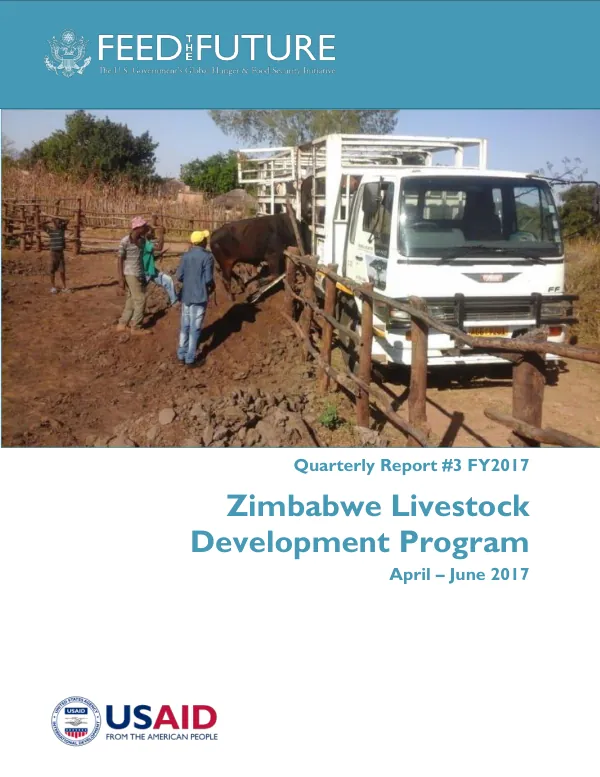
Quarterly Report #3 FY2017: Feed the Future Zimbabwe Livestock Development Program
The Feed the Future Zimbabwe Livestock Development program began on June 23, 2015, and runs through June 22, 2020.
2017 · 82 pages
Sign in to readA free account is required to download.
Abstract
The program aims to reduce rural poverty and improve household food security, incomes, and nutritional status among beef and dairy smallholder producers through increased production, productivity, and market linkages. Activities are confined to agro-ecological regions III, IV, and V, focusing on low-income and food-insecure households with the potential to move from subsistence to small-scale commercial farmers. The program seeks to improve the capacity of its local partners to implement agricultural development programs. Commercialization of small-scale beef and dairy farmers on communal and non-contested land is being achieved by raising efficiencies in beef and dairy production systems, facilitating access to inputs, technology, finance, and credit, linking producers to local, national, regional, and international buyers, training farmers to adopt good agricultural, business, and animal husbandry practices, and strengthening the capacity of the program's local partners. The program is building demand for smallholder-produced beef and dairy products by focusing on quality, continuity of supply, and cost-competitiveness. It collaborates with the Feed the Future Zimbabwe Crop Development program and other donor programs to provide specialized technical support to produce nutritious crops that sustainably increase the availability of these foods among beneficiary households. Fintrac is implementing the program in partnership with subcontractor ABS-TCM and other local private companies, non-governmental organizations (NGOs), the Division of Livestock Production and Development, the Department of Veterinary Services, and other Zimbabwean government departments involved in the beef and dairy value chains. Local non-governmental organizations and commercial companies work with the program as development partners, to co-fund purchases of essential inputs and new technologies for demonstration purposes. The program directly contributes to food availability and access by concurrently increasing production and raising incomes of rural households in selected areas. The program's activities are focused on increasing production and productivity, improving market linkages, and enhancing the capacity of local partners to implement agricultural development programs. The program's implementation is focused on three key areas: increasing production and productivity, improving market linkages, and enhancing the capacity of local partners. To achieve these objectives, the program is implementing a range of activities, including training farmers to adopt good agricultural, business, and animal husbandry practices, facilitating access to inputs, technology, finance, and credit, and linking producers to local, national, regional, and international buyers. The program is also working to strengthen the capacity of local partners to implement agricultural development programs. The program's impact is being monitored and evaluated through a range of indicators, including increases in production and productivity, improvements in market linkages, and enhancements in the capacity of local partners. The program's progress is being reported quarterly, providing a snapshot of the program's activities, achievements, and challenges. The program's financial summary is also provided, detailing the program's expenditures and income.