PARTNERS OF THE AMERICAS
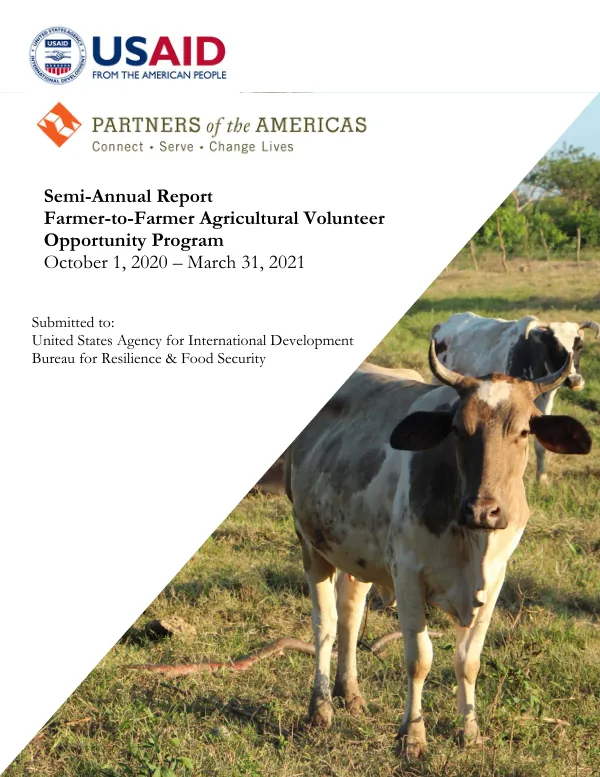
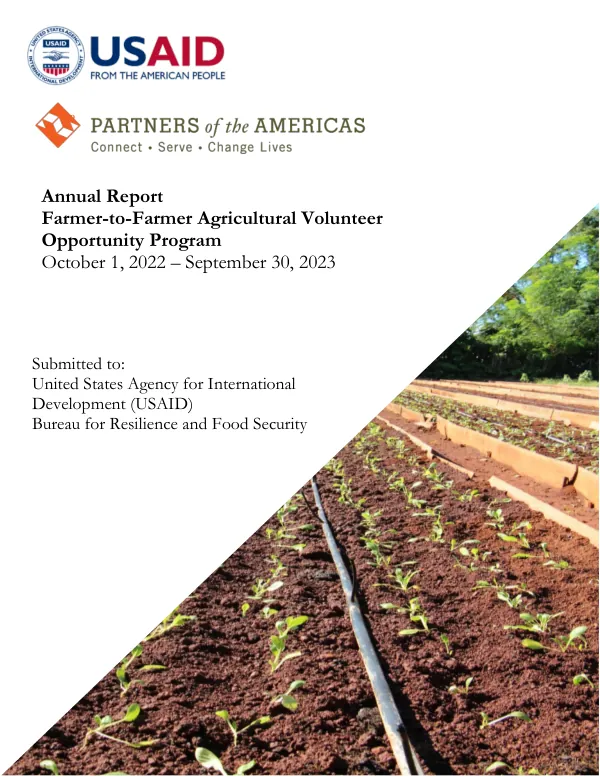
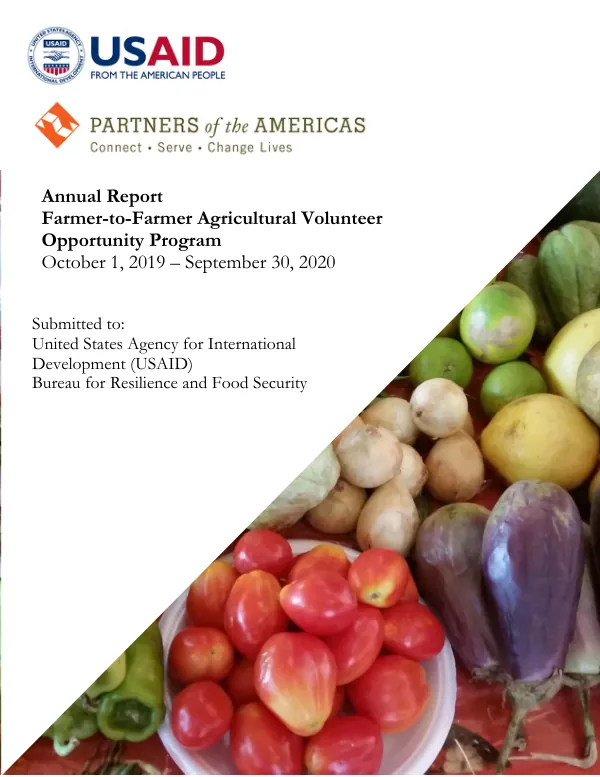
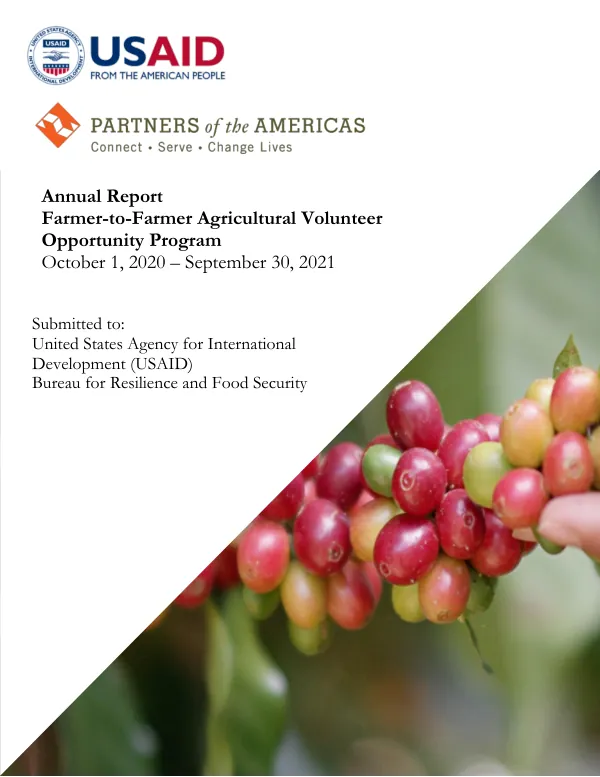
Annual Report: Farmer-to-Farmer Agricultural Volunteer Opportunity Program
The Farmer-to-Farmer Agricultural Volunteer Opportunity Program (AVOP) is a project implemented by Partners of the Americas (POA) in collaboration with the United States Agency for International Development (USAID).
2021 · 16 pages
Sign in to readA free account is required to download.
Abstract
The program aims to promote agricultural development and food security in developing countries through the exchange of knowledge, skills, and best practices between farmers and agricultural experts. Throughout the fiscal year 2021, POA continued to implement activities under the two main components of AVOP: sub-award management and knowledge management. Under the sub-award component, POA released the third-round of the Request for Applications (RFA) to award three sub-awards of $200,000 each for 16-month projects. POA also continued to deliver capacity building activities for sub-awardees, including The High Atlas Foundation, The Grameen Foundation, University of Tennessee, Purdue University, and the Browse & Grass Growers Cooperative. Activities under the knowledge management component focused on managing and updating F2F digital media platforms, facilitating Community of Practice committee meetings, organizing the FY21 Implementers Meeting (IPM), hosting three F2F seminars, and managing the F2F website. Additionally, POA collaborated with NCBA CLUSA, and Winrock International to plan and execute the F2F 35th Anniversary Celebration and associated social media campaign in December 2020. In April 2021, POA released an RFA for the third round Small Grants Competition to award three sub-awards of up to $200,000 each. POA was more intentional in its effort to diversify the pool of F2F implementers and test innovative approaches. Specifically, POA limited eligibility criteria to encourage applications from new implementers, minority-serving, or women-led organizations. Additionally, POA elected to make sub-awards under this round Fixed Amount Awards, rather than cost-reimbursable, to make it feasible for entities with less experience managing federal awards to apply. POA conducted targeted outreach to female-led or female majority organizations, minority serving institutions, minority-controlled private and voluntary organizations, and minority-owned businesses. As a result, POA was able to share the RFA with a more comprehensive and diverse list of entities. POA also held a live webinar early in the competition to provide additional details, and answer questions about AVOP, F2F, and the RFA. Lastly, an online Q&A document was shared with prospective applicants and regularly updated throughout the competition. During Q4, USAID invited POA to participate in the Bureau for Resilience and Food Security’s DEI Speaker Series to lead a presentation on AVOP’s strategies to diversify F2F implementing partners via its third-round Small Grants Competition. POA explained AVOP’s strategies and left time for questions. At the end of the presentation, participants offered useful suggestions for further promoting diversity among F2F implementing partners. In total, AVOP received 17 applications by the June 8th deadline. Of these applicants, four did not pass the eligibility screening—two were not U.S.-based entities and two others submitted incomplete applications. Thus, only 13 applications were reviewed and scored by the external technical review panel, which subsequently recommended three to move forward in the competition: Engineers without Borders (Guatemala), Convoy of Hope (the Bahamas), and CRDF Global (Ukraine). After receiving no objections from each of the relevant USAID Missions, POA worked closely with each of the apparently successful applicants to develop their program descriptions, budgets, and indicator targets. Under the Knowledge Management component, AVOP continued promoting and sharing content via digital media platforms to highlight F2F and attract prospective volunteers. POA also led and facilitated activities for the F2F Community of Practice (CoP) to share best practices and strengthen implementation. This included attending and at times leading CoP committee meetings, sharing notes and resources on the F2F Implementer Resource Center, and organizing seminars to share best practices and discuss new implementation strategies. During Q1, POA organized and held the FY21 IPM. For the first time, the IPM was hosted virtually over the course of four days, which allowed over 120 F2F global staff from the eight core implementers and five sub-awardees to attend. POA worked closely with USAID and F2F implementing organizations to develop agendas and content for each session. Topics included host organization needs assessments and development strategies, social inclusion and gender equity in F2F activities, access to finance, volunteer recruitment, USAID Mission engagement, effective communications and outreach strategies, youth and extension, scaling F2F impact, monitoring, evaluation, and learning related problems, challenges, and best practices, and COVID-19-related challenges, lessons learned, and planning. Throughout Q1, POA also collaborated with NCBA CLUSA and Winrock International to plan and execute the virtual F2F 35th Anniversary Celebration. This event, held during the week of the FY21 IPM, featured prominent guest speakers, including