ABT ASSOCIATES
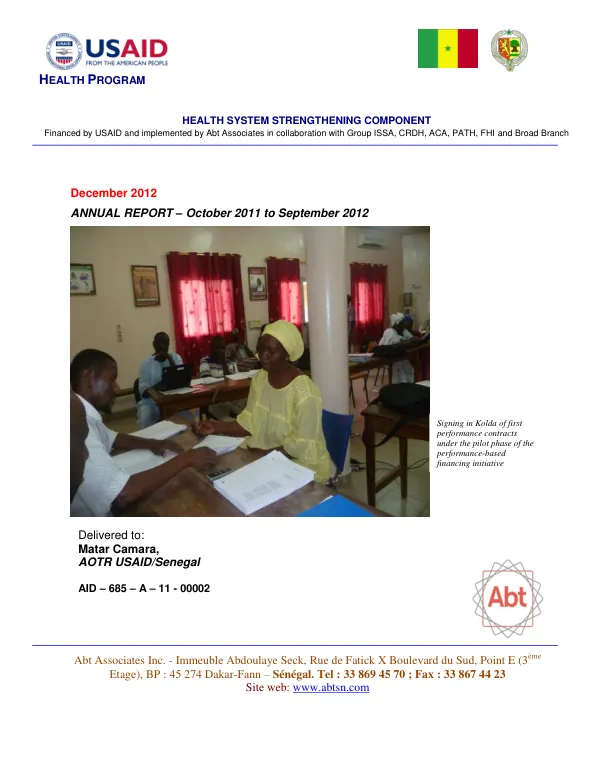
Annual Report – Health System Strengthening Component (H2S) Year 1
The Health System Strengthening (H2S) Component is a key instrument of USAID/Senegal's 2011-2016 Health Program.
2012 · 59 pages
Sign in to readA free account is required to download.
Abstract
The main objective of the Component is to improve the performance of the decentralized public health system at regional and district levels, supported by effective policies, planning, and budgeting at the central level of the Ministry of Health and Social Action (MOH). The Component aims to contribute significantly to the achievement of Intermediate Result 3 of the Health Program's results framework, which is to improve the performance of the health system. The H2S Component works at the central level and in ten regions of Senegal, including Diourbel, Fatick, Kaffrine, Kaolack, Kolda, Louga, Sédhiou, Thiès, Ziguinchor, and the departments of Pikine and Rufisque in the Dakar region. The Component is based on the strategic directions set out in the National Health Development Plan (PNDS) for 2009-2018. The main objective of the Component is to improve the management of district and regional health teams and to develop and implement national level policies to improve health system performance. The H2S Component is implemented by Abt Associates Inc. in collaboration with Group ISSA, CRDH, ACA, PATH, FHI, and Broad Branch. The Component is financed by USAID and is expected to contribute significantly to the achievement of the Health Program's results framework. The Component works to improve the performance of the health system by supporting the development and implementation of national level policies, improving management of district and regional health teams, and strengthening health system governance and leadership. The Component has made significant progress in its first year, with start-up activities conducted in all ten regions. The Component has also made progress in Sub-Component A, which focuses on management and health systems at regional and district levels. The Component has established a Performance-Based Financing system, which aims to improve the performance of health facilities and services. The Component has also made progress in Sub-Component B, which focuses on social financing mechanisms, and has established incentivized support frameworks to support the development of health insurance coverage. The Component has also made progress in Sub-Component C, which focuses on national level health policies and systems. The Component has supported the development and implementation of national level policies to improve health system performance, and has made progress in monitoring the PNDS. The Component has also made progress in Sub-Component D, which focuses on coordination and monitoring/evaluation, and has established a coordination mechanism to support the implementation of the Component. Despite the progress made, the Component has faced several challenges, including limited capacity at the regional and district levels, limited resources, and limited coordination among stakeholders. However, the Component has also learned several lessons, including the importance of building capacity at the regional and district levels, the need for effective coordination among stakeholders, and the importance of establishing clear policies and procedures. The Component has made significant progress in its first year, and is expected to continue to make progress in the coming years. The Component will continue to work to improve the performance of the health system, and to support the development and implementation of national level policies to improve health system performance. The Component will also continue to work to strengthen health system governance and leadership, and to improve the management of district and regional health teams.