USAID DEC
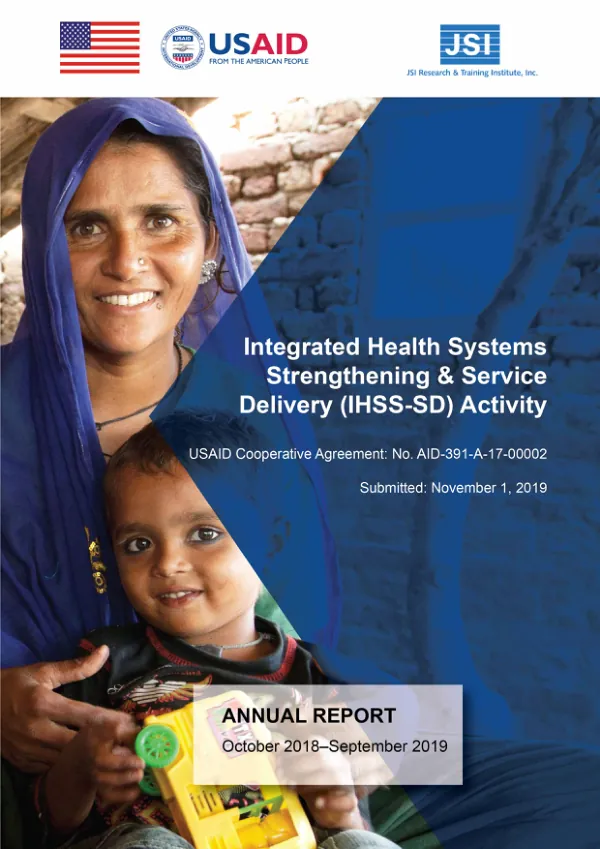
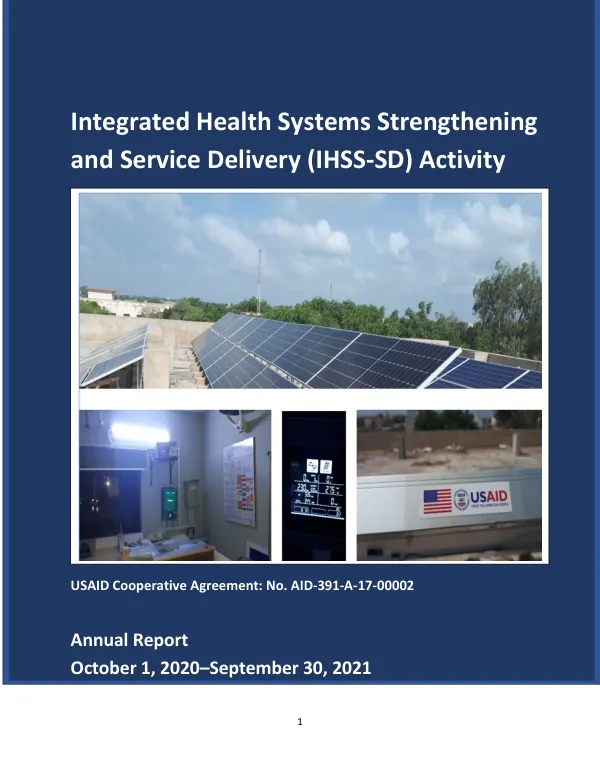
Annual Report: Integrated Health Systems Strengthening and Service Delivery (IHSS-SD) Activity
Sign inJSI RESEARCH & TRAINING INSTITUTE, INC
Annual Report: Integrated Health Systems Strengthening and Service Delivery (IHSS-SD) Activity
The IHSS-SD Activity in Pakistan began its third year of implementation in October 2020, amidst the challenges posed by the COVID-19 pandemic.
2021 · 40 pages
Sign in to readA free account is required to download.
Abstract
The program continued to operate in four districts of Khyber Pakhtunkhwa province and two districts in Sindh province. Under the Global Health Security Agenda, the program implemented COVID-19 and tuberculosis (TB) activities nationwide. COVID-19 support efforts were provided throughout the country, focusing on infrastructure strengthening, capacity building in disease surveillance, and human resource development. Energy backup systems, IT support, and connectivity were established in various health facilities to enhance their operational capacity. The program also conducted training sessions for healthcare workers on disease surveillance, contact tracing, and case management. The command and control centers (CCC) established in all six provinces played a crucial role in COVID-19 monitoring and response. These CCCs were equipped with Provincial Disease Surveillance & Response Units (PDSRUs) and district disease surveillance and response units (DDSRUs), which served as the primary backbone for disease surveillance and response efforts. In addition to COVID-19 support, the program continued to implement TB activities, focusing on programmatic management of drug-resistant tuberculosis (PMDT) and drug-sensitive tuberculosis (DS-TB). The program also supported the establishment of TB diagnostic centers and provided training to healthcare workers on TB diagnosis and treatment. The IHSS-SD Activity also made significant progress in health system strengthening, particularly in the areas of district health and population management teams (DHPMTs) and restructuring of the Department of Health (DOH) in Sindh. The program supported the establishment of DHPMTs in all districts, which enabled effective coordination and management of health services at the district level. Furthermore, the program strengthened health facilities with improved readiness, focusing on infection prevention and control (IPC), quality improvement (QI), and supportive supervision. The program also supported the establishment of mobile health service units (MHSUs) to improve access to basic health services in remote areas. In terms of civic engagement, the program conducted health awareness sessions with communities, focusing on hygiene and handwashing practices. The program also supported the implementation of hygiene and handwashing sessions in primary schools, aiming to promote healthy behaviors among children. The IHSS-SD Activity also made significant progress in governance and accountability, particularly in the areas of monitoring and supervisory systems, the Khyber Pakhtunkhwa Integrated Management Information System for Health (KP IMIS), and the scaling up of the Lady Health Worker-MIS (LHW-MIS) in all districts of Khyber Pakhtunkhwa. Overall, the IHSS-SD Activity made significant progress in its third year of implementation, despite the challenges posed by the COVID-19 pandemic. The program continued to strengthen health systems, improve access to health services, and promote healthy behaviors among communities.