USAID DEC
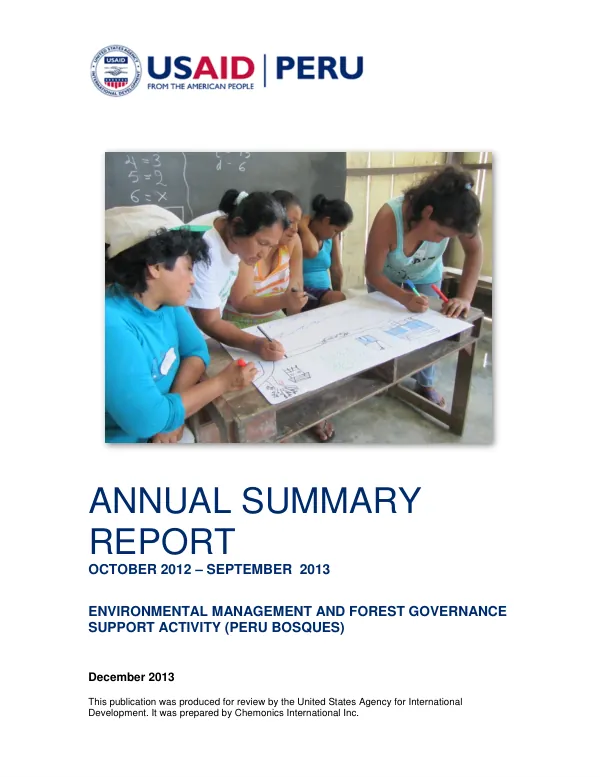
Annual Summary Report October 2012 – September 2013: Environmental Management and Forest Governance Support Activity (Peru Bosques)
Sign inCHEMONICS
Annual Summary Report October 2012 – September 2013: Environmental Management and Forest Governance Support Activity (Peru Bosques)
The National Approach to forest governance in Peru is guided by the Forestry and Wildlife Law, which regulates forestry exploitation and wildlife management.
2013 · 45 pages
Sign in to readA free account is required to download.
Abstract
The law establishes the General Directorate for Forestry and Wildlife (DGFFS) as the primary authority responsible for implementing forestry policies and regulations. The DGFFS is supported by the National Forestry and Wildlife Service, which provides technical assistance and capacity building to regional forestry authorities. Regional Environmental Authorities (ARA) play a crucial role in implementing forestry policies and regulations at the regional level. In Loreto, Ucayali, and Madre de Dios, regional authorities have developed institutional capacities to manage environmental resources and implement forestry management plans. Public investment in environmental management has been expanded to support the development of regional conservation areas and the implementation of forest and biodiversity management plans. Interculturalism and gender are key considerations in forest governance in Peru. The ORAU Forestry Community Oversight Committee has been established to promote community participation and oversight in forestry management. Native communities have been informed about the process of developing Local Forest and Wildlife Management Plans (LFFS), which aim to promote sustainable forest management and community development. Institutional strengthening of the Confederation of Amazon Nations of Peru (CONAP) has also been supported to enhance the capacity of indigenous organizations to participate in forest governance. Forestry management and biodiversity conservation are critical components of the Peru Bosques program. National and regional approaches to forestry management have been implemented to promote sustainable forest management and reduce deforestation. The program has supported the development of regional conservation areas, including the Ampiyacu Apayacu Regional Conservation Area and the Upper Nanay Pintuyacu Chambira Regional Conservation Area. Economic development has also been a key focus of the program, with support provided to firms participating in ExpoAmazonica 2013. The Peru Bosques program has identified opportunities for further development, including the expansion of public investment in environmental management and the strengthening of regional environmental authorities. Challenges have also been identified, including the need to address deforestation and forest degradation, and to promote sustainable forest management practices. Best practices have been identified, including the use of community-based forest management and the promotion of gender equality in forest governance. Priorities for the next year include the continued development of regional conservation areas and the implementation of forest and biodiversity management plans.