USAID
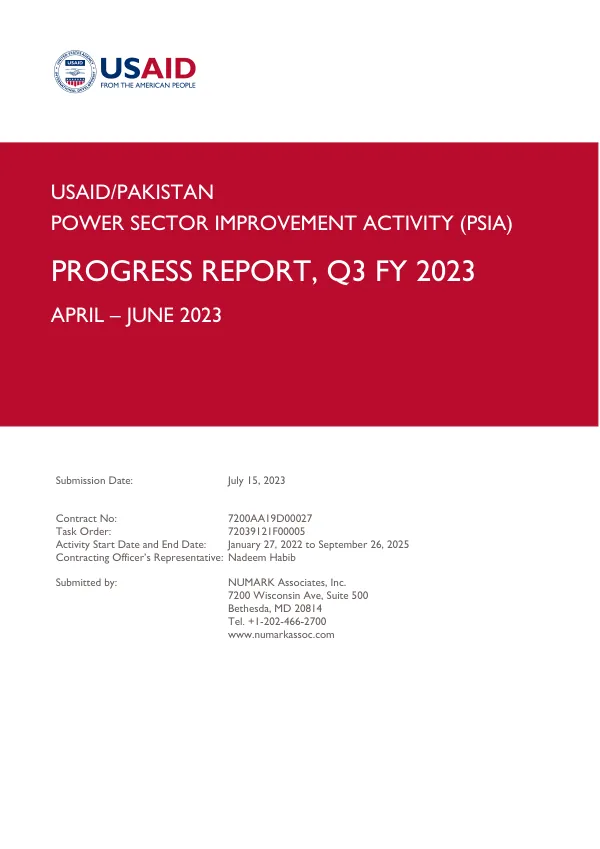
Annual Work Plan FY 2024 POWER SECTOR IMPROVEMENT ACTIVITY (PSIA)
The Power Sector Improvement Activity (PSIA) in Pakistan is a USAID-funded initiative aimed at improving the country's power sector.
2024 · 72 pages
Sign in to readA free account is required to download.
Abstract
The activity began on January 27, 2022, and is scheduled to conclude on September 26, 2025. The primary objective of PSIA is to increase power sector competition through support to develop Pakistan's wholesale electricity market. The activity is structured around five key objectives, with the first objective focusing on increasing power sector competition through support to develop Pakistan's wholesale electricity market. This objective is further divided into five sub-activities, including preparatory activities, transition, and implementation support for the wholesale power market. The sub-activities involve assistance to the Ministry of Energy on policies, rules, and institutional reforms required for the Competitive Trading and Balancing Company (CTBCM) framework. Another sub-activity involves support for the transformation of the Central Power Purchasing Agency-Guarantee (CPPA-G) under the CTBCM roadmap. This includes assistance to the National Electric Power Regulatory Authority (NEPRA) on developing regulations, rules, codes, and guidelines for the power sector. Additionally, support is provided to the National Transmission and Despatch Company (NTDC) and the National Power Control Center (NPCC) in transitioning to the CTBCM framework. The second objective of PSIA focuses on improving the management and operation of the transmission and distribution (T&D) system. This objective is further divided into three sub-activities, including institutional capacity development and technical activities for integrated system and energy plans. The sub-activities involve human resource development and capacity building for NPCC, support to NPCC/NTDC in the development of the Integrated System Plan 2024, and the development and implementation of a grid data monitoring mechanism at NPCC. The third objective of PSIA involves improving the management, operations, and financial viability of distribution utilities. This objective is further divided into three sub-activities, including commercial service orientation and revenue optimization at DISCOs, DISCO organizational restructuring, business process re-engineering, and needs-based capacity building. The sub-activities involve rehabilitation work for flood-affected areas and the development of an accurate short-term load forecasting (STLF) system to enhance dispatch at NPCC. The PSIA activity is managed by NUMARK Associates, Inc. and the Energy and Security Group, LLC, in collaboration with the Government of Pakistan and other stakeholders. The activity is expected to contribute to the improvement of the power sector in Pakistan, with a focus on increasing competition, improving management and operation of the T&D system, and enhancing the financial viability of distribution utilities. The PSIA activity is structured around a work plan matrix, which outlines the activities, outcomes, timelines, deliverables, and indicators for each objective. The work plan matrix provides a detailed framework for the implementation of the activity, with specific tasks and milestones outlined for each sub-activity. The matrix also includes a timeline for the completion of each task, as well as indicators for measuring progress and success. The PSIA activity is expected to have a significant impact on the power sector in Pakistan, with potential benefits including increased competition, improved management and operation of the T&D system, and enhanced financial viability of distribution utilities. The activity is expected to contribute to the achievement of the Government of Pakistan's power sector development goals, including increasing access to electricity, improving the reliability and quality of the power supply, and promoting economic growth and development.