CDM INTERNATIONAL, INC.
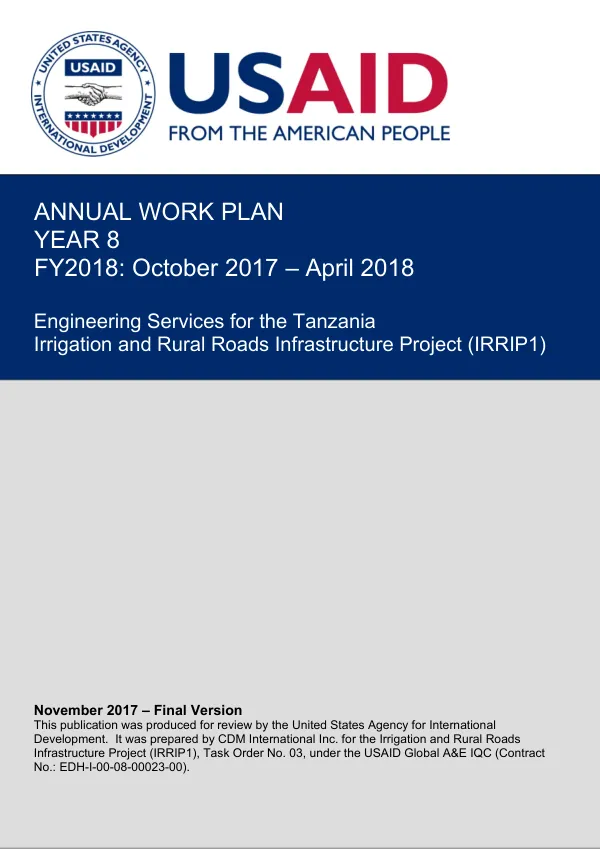
Annual Work Plan, Year 8 FY2018: October 2017 - April 2018
The Tanzania Irrigation and Rural Roads Infrastructure Project (IRRIP1) is a USAID-funded initiative aimed at enhancing agricultural productivity on irrigated land and increasing rural employment and farm income through the rehabilitation of irrigation infrastructure.
2018 · 41 pages
Sign in to readA free account is required to download.
Abstract
The project's scope initially included the planning, design, procurement support, and construction supervision of rehabilitation works on the 2,000-ha Dakawa irrigation and drainage (I&D) system, the potential 500-ha Dakawa expansion, and the new 620-ha Mgongola scheme. However, a final Environmental Assessment submitted to USAID in 2015 recommended against a basin irrigation scheme at Mgongola, and the 500-ha Dakawa Expansion was also not pursued due to concerns about water abstraction from the Wami River. The project currently focuses on planning, design, procurement, and construction supervision activities at Dakawa, covering upgrades to the pump station, improvements to the existing I&D infrastructure, and establishment of the physical environment for the irrigation scheme to be operated in an environmentally sustainable way. The specific objectives of the rehabilitation of the Dakawa irrigation scheme are to enable water to be supplied more effectively and at less cost, provide flow control and measurement structures to better manage water for higher crop yields, mitigate the environmental and social impacts caused by the existing scheme, and establish the physical environment for the irrigation scheme to be operated in an environmentally sustainable way. The rehabilitation of the Dakawa irrigation scheme involves four separate construction projects: Contract 01 – Rehabilitation of Dakawa Irrigation Scheme – Pump Station Civil and Site Improvements, Contract 02 – Dakawa Pump Station Upgrades, Contract 03 – Rehabilitation of Dakawa Irrigation Scheme – Advance Works, and Contract 04 – Rehabilitation of Dakawa Irrigation Scheme – Irrigation Drainage Works. These projects aim to upgrade the pump station, improve the existing I&D infrastructure, and establish the physical environment for the irrigation scheme to be operated in an environmentally sustainable way. The project currently involves the rehabilitation of the 2,000-hectare (4,950 acre) Dakawa irrigation scheme, which consists of a 5-m3/sec pumping station that lifts water from the Wami River into a 7.4-km main canal that feeds 25 kilometers of secondary canals to deliver water to the farm plots. The pumping/irrigation season typically runs from mid-March to mid-August each year. The project currently focuses on planning, design, procurement, and construction supervision activities at Dakawa, covering upgrades to the pump station, improvements to the existing I&D infrastructure, and establishment of the physical environment for the irrigation scheme to be operated in an environmentally sustainable way. The project's goals are to be accomplished by implementing four separate construction projects, which aim to upgrade the pump station, improve the existing I&D infrastructure, and establish the physical environment for the irrigation scheme to be operated in an environmentally sustainable way. The project's objectives are to enable water to be supplied more effectively and at less cost, provide flow control and measurement structures to better manage water for higher crop yields, mitigate the environmental and social impacts caused by the existing scheme, and establish the physical environment for the irrigation scheme to be operated in an environmentally sustainable way.