CDM INTERNATIONAL, INC.
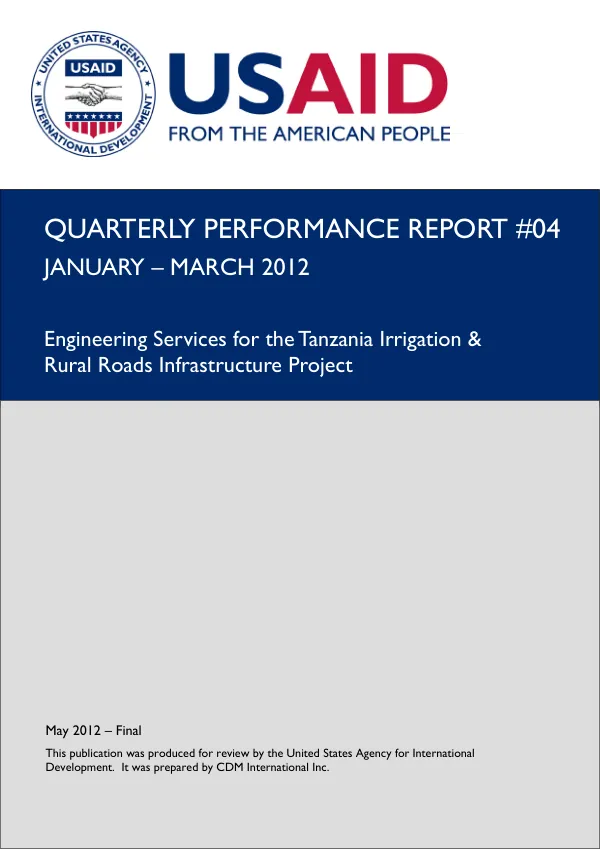
Quarterly Performance Report #04: January - March 2012
The Tanzania Irrigation and Rural Roads Infrastructure Project is a comprehensive project aimed at enhancing agricultural productivity in the Morogoro region.
2012 · 41 pages
Sign in to readA free account is required to download.
Abstract
The project is part of the Feed the Future (FTF) Initiative, which was reaffirmed by the U.S. Government in 2000 to reduce global hunger and poverty. The project's overarching goal is to increase agricultural productivity in an integrated approach, focusing on the rehabilitation of irrigation and rural road infrastructure. The project is divided into three key components: Irrigation Infrastructure, Rural Roads Infrastructure, and Institutional Capacity Building. The Irrigation Infrastructure component involves the rehabilitation and development of functioning irrigation schemes at Dakawa and Morogoro, covering a total of 3,100 hectares. The Rural Roads Infrastructure component includes the rehabilitation and upgrade of approximately 100 km of rural roads connecting production areas with markets. The Institutional Capacity Building component involves a review of existing capacity building and training plans, with recommendations for further development and implementation. In March 2011, CDM International Inc. (CDM Smith) submitted an implementation budget, schedule, and technical approach to accommodate USAID's available funding for a phased implementation approach. However, due to additional funding, USAID requested that CDM Smith re-structure the implementation budget and schedule, which led to a shift in scope and a more sustained in-country presence. The revised scope includes expanding the Dakawa scheme by approximately 500 hectares and omitting activities at Sonja due to unresolved land tenure issues. The project team has proceeded with the revised activity plan, shifting efforts to address the broader assessment and design work for the full Dakawa scheme. CDM Smith and USAID have been discussing changes to the budget and timeframe for the project, which will be included in a contract modification. The project's progress is documented in this Quarterly Performance Report, which highlights the accomplishments and challenges faced during the January-March 2012 period. During this quarter, the project team has made significant progress in implementing the revised activity plan. Key accomplishments include the completion of the preliminary engineering report for the Dakawa scheme, the establishment of a project office in Morogoro, and the initiation of stakeholder liaison work. The team has also identified and addressed several issues and constraints, including unresolved land tenure issues at Sonja. The project's management and staff have been actively engaged in addressing these challenges, and the team has made significant progress in implementing the revised activity plan. The project's financial expenditure has been closely monitored, and the team has ensured that all expenditures are in line with the approved budget. In conclusion, the Tanzania Irrigation and Rural Roads Infrastructure Project has made significant progress during the January-March 2012 period. The project team has implemented the revised activity plan, addressing several challenges and constraints, and has made significant progress in implementing the project's objectives. The project's management and staff have been actively engaged in addressing these challenges, and the team has ensured that all expenditures are in line with the approved budget.
Related documents