TETRA TECH DPK
Anti-Corruption Follow-up Session - Report October 2013
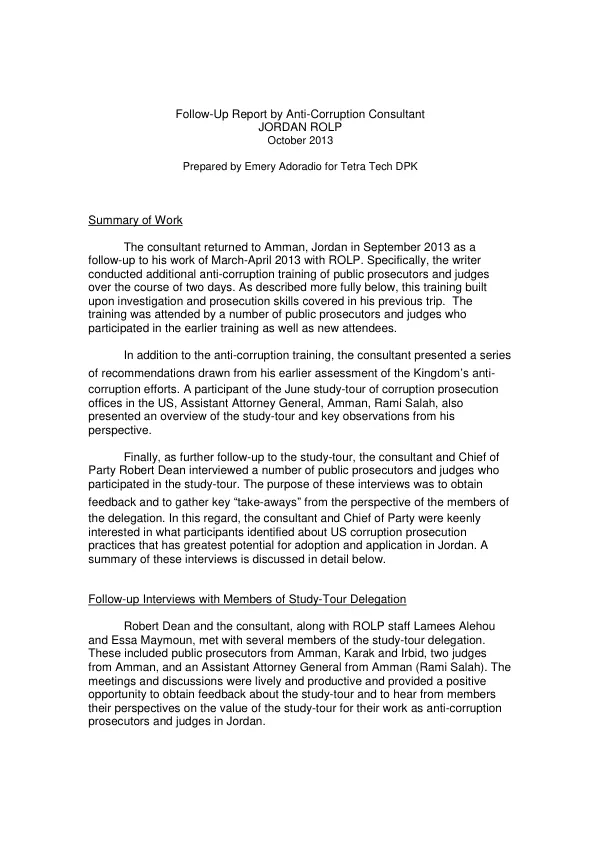
The anti-corruption follow-up program in Jordan was conducted in September 2013, building upon the consultant's previous work with the Rule of Law Program (ROLP).
2013 · 8 pages
Sign in to readA free account is required to download.
Abstract
The program aimed to provide additional anti-corruption training to public prosecutors and judges, as well as to present recommendations drawn from the consultant's earlier assessment of the Kingdom's anti-corruption efforts. The training was attended by a number of public prosecutors and judges who had participated in the earlier training, as well as new attendees. The consultant presented a series of recommendations, which included the importance of building effective relationships between public prosecutors and police/investigators in the US, as well as the critical role of cooperating witnesses/defendants in US corruption cases. The training also focused on a corruption case scenario, which involved corrupt public officials engaged in a bribery scheme in a government contracting business. The scenario was distributed to participants in stages, encouraging critical analysis, participation, and discussion among the attendees. The discussions and participation were very productive and lively, with participants demonstrating their ability to problem-solve various investigative and prosecution issues presented in the case scenario. In addition to the training, a member of the study-tour delegation, Assistant Attorney General Rami Salah, presented his impressions of US prosecution offices. Judge Salah cited the strong prosecutor/police relationship in US offices and its importance in building effective corruption investigations and cases. He also made additional comments on the importance of circumstantial evidence, confidentiality in requests for bank records, and prosecutorial discretion. The consultant also presented his findings made as part of a broad assessment of Jordan's anti-corruption efforts. The presentation led to some lively and heated discussions, with a majority of the participants expressing the view that the creation of a new, national anti-corruption "strike force" was unnecessary. Instead, they suggested building upon current agencies and offices, such as the Anti-Corruption Commission (ACC), rather than creating new ones. The consultant's time in Jordan provided a valuable opportunity to bring closure to the study-tour by seeking input and feedback from a representative sample of delegation members. The additional training built upon and expanded the investigation skills developed during the prior sessions, and receiving direct feedback from public prosecutors and judges about Jordan's anti-corruption efforts provides value for future work in this area. The follow-up program was conducted in Amman, Jordan, on September 18-19, 2013, with a number of key events and presentations taking place. The program included a welcoming speech by Robert Dean, Chief of Party, as well as an overview of the program by Emery Adoradio, Anti-Corruption Prosecutor. The program also included a review of anti-corruption efforts in Jordan, as well as a presentation by Judge Salah on his impressions of US prosecution offices. The consultant's assessment of Jordan's anti-corruption efforts highlighted the need for building effective relationships between public prosecutors and police/investigators, as well as the critical role of cooperating witnesses/defendants in US corruption cases. The assessment also suggested that the creation of a new, national anti-corruption "strike force" was unnecessary, and that building upon current agencies and offices, such as the ACC, would be a more effective approach. The follow-up program provided a valuable opportunity for public prosecutors and judges to receive additional training and to provide feedback on Jordan's anti-corruption efforts. The program also highlighted the importance of building effective relationships between public prosecutors and police/investigators, as well as the critical role of cooperating witnesses/defendants in US corruption cases.