USAID DEC
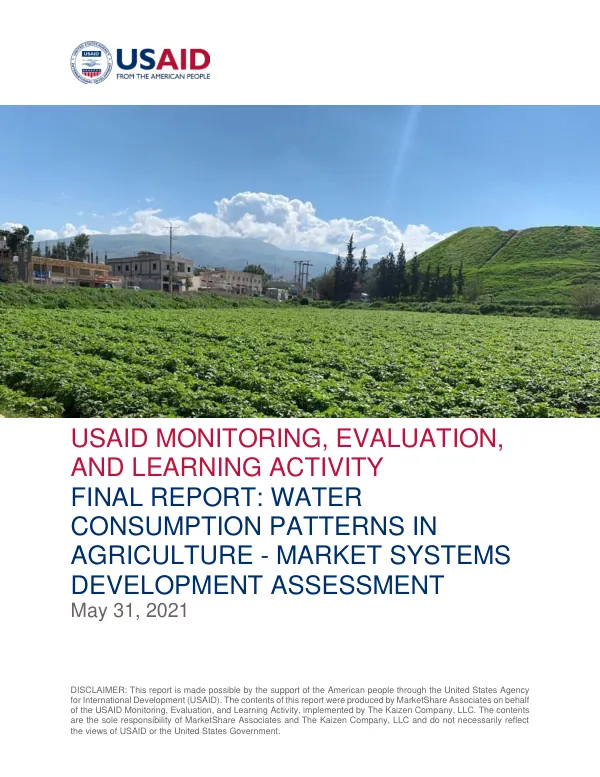
USAID Monitoring, Evaluation, and Learning Activity FINAL REPORT: WATER CONSUMPTION PATTERNS IN AGRICULTURE - MARKET SYSTEMS DEVELOPMENT ASSESSMENT
Sign inMARKET SHARE ASSOCIATES
USAID Monitoring, Evaluation, and Learning Activity FINAL REPORT: WATER CONSUMPTION PATTERNS IN AGRICULTURE - MARKET SYSTEMS DEVELOPMENT ASSESSMENT
The agricultural development initiative in Jordan began with a focus on improving water use efficiency in agriculture.
2021 · 44 pages
Sign in to readA free account is required to download.
Abstract
The initiative, funded by the United States Agency for International Development (USAID), aimed to increase farm and household use of water-saving technologies through a market systems development approach. The assessment used quantitative and qualitative data from primary and secondary sources, including 173 semi-structured interviews with farmers and secondary sources such as Jordan's 2017 agricultural census and a previous water use study conducted by USAID in 2012. Jordan's agriculture receives low export and sometimes domestic prices, with key crops such as tomatoes, peaches, and sweet melons being major exports. However, domestic market prices are prone to drops due to gluts influenced by the volatility of Jordan's neighbors' markets and trade routes. Irrigated agriculture is constrained by water shortages, contamination, and high electricity prices, leading to reduced yields, revenue, and profitability. Adoption of water conservation technologies is constrained by capital and know-how more than awareness. Most farmers interviewed knew about some water-conserving technologies they were not using, primarily due to their cost and lack of knowledge on how to use them. Extension services are not widespread, and few farmers interviewed said that their input suppliers offered technical services. Knowledge of the potential water-savings of different water conservation technologies is limited, constraining the government, private sector, and NGOs from making rational water conservation technology and practice recommendations. The assessment identified 13 key crops that together use an estimated 75 percent of Jordan's agricultural water, with olives leading the way at 35 percent of all agricultural water use. By focusing on these highest water-use crops, the assessment aims to identify findings and conclusions that can lead to high-impact recommendations for USAID. There is potential for Jordan to save significant water in agriculture, with a recent study estimating that if Jordan could replicate Israel's water use efficiency, it could reduce its water use by 33 percent. In non-agricultural services, water use is also a concern, with hotels, hospitals, and restaurants showing limited awareness of water-saving technologies and practices. Businesses may not monitor and optimize their water use, and water savings technology sellers often do not market products based on water savings. Government coordination related to commercial water use could be improved, with respondents reporting a lack of an overall vision for water use conservation across different sectors and a siloed approach to policy and program implementation. The Water Innovation Technologies (WIT) Project, part of the assessment, found that WIT's need to meet overly ambitious short-term water-saving targets negatively influenced the market systems design of several of WIT's activities. The project also found that the business case for water-saving is emerging but must be strengthened and integrated into the project strategy. WIT's investment fund may have unintentionally limited more innovative applicants who had less experience working with donors. Market actors are interested in engaging with the project, but progress with the government has been slower.
Related documents