USAID DEC
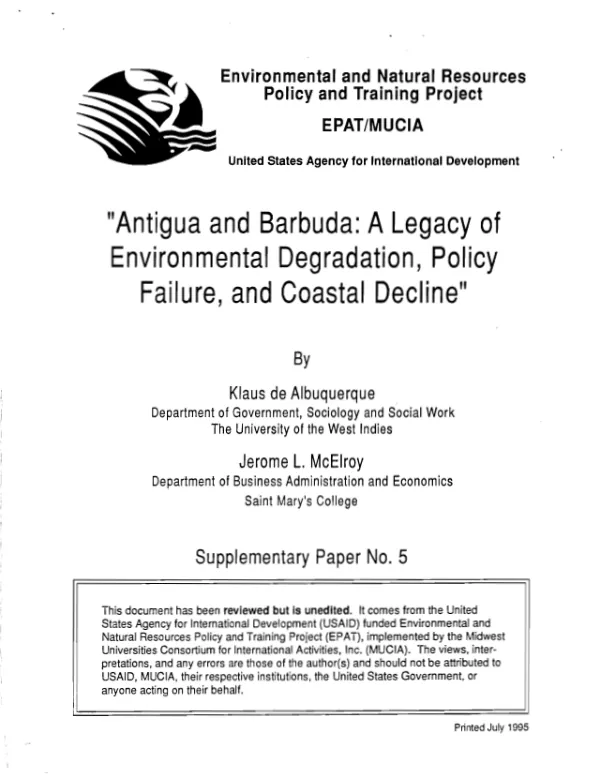
Antigua and Barbuda : a legacy of environmental degradation, policy failure, and coastal decline
Sign inMIDWEST UNIVERSITIES CONSORTIUM FOR INTERNATIONAL ACTIVITIES, INC. (MUCIA)
Antigua and Barbuda : a legacy of environmental degradation, policy failure, and coastal decline
This case study describes the impacts of tourism and residential growth on coastal resources in Antigua and Barbuda.
de Albuquerque, Klaus; McElroy, Jerome L. · 1995
Sign in to readA free account is required to download.
Abstract
The first section provides the demographic and economic context, emphasizing the role of tourism and the findings of the 1991 census regarding trends in urbanization/suburbanization and population density. The second provides a comprehensive qualitative assessment of the impacts of tourism and residential growth on coastal resources. Section three examines the roles and responsibilities of various state agencies and institutions involved with coastal resource conservation, and discusses the major NGOs concerned with coastal conservation. The fourth section examines the local and regional institutional context. The former includes discussion of legislation and enforcement, political actors, and the media, while the latter explores the tourism destination life cycle, including the position of Antigua-Barbuda in the context of 20 small Caribbean islands. The fifth assesses the impacts of grassroots NGOs and stakeholder self-management groups on coastal preservation by reviewing five case studies -- four of resort development (Jolly Harbour, Marina Bay, and Coconut Hall in Antigua, the "K" Club in Barbuda) and one of sand mining (Barbuda). Recapping the major threats to coastal resources, the last section presents a comprehensive policy response which emphasizes integrated planning, widespread NGO and community participation, environmental education, and -- in contrast to past neglect -- a serious commitment to coastal conservation at the highest levels of government. (Author abstract)
Related documents
![Intercost [i.e. Intercoast] Newsletter reflective and retrospective, 1986 to 2000](https://covers.devme.ai/gen/23997.webp)