USAID DEC
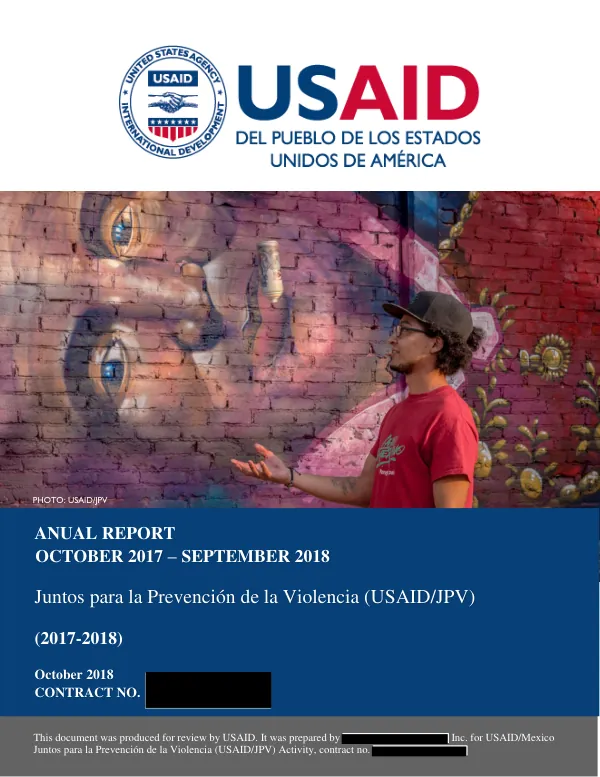
ANUAL REPORT OCTOBER 2017 – SEPTEMBER 2018 Juntos para la Prevención de la Violencia (USAID/JPV) (2017-2018)
Sign inCHEMONICS
ANUAL REPORT OCTOBER 2017 – SEPTEMBER 2018 Juntos para la Prevención de la Violencia (USAID/JPV) (2017-2018)
The Juntos para la Prevención de la Violencia Activity (USAID/JPV) continued its work for the reduction of violence and crime in Mexico in Fiscal Year 2018.
2018 · 66 pages
Sign in to readA free account is required to download.
Abstract
The program achieved significant successes at the national and regional levels, consolidating its work based on the Local Systems Framework. This framework facilitated more intricate and sophisticated collaboration in the regions where the program operates, as well as outside of them, indicating the effectiveness of its strategy. The program's gender strategy focused on family violence and sexual violence. In the realm of family violence, USAID/JPV partnered with local organizations in Ciudad Juárez, Chihuahua, and Pachuca, Hidalgo, to support the design and implementation of a Care Model for Child and Adolescent Victims of Family Violence. A strengthened model was transferred to the governments of both cities. For sexual violence, USAID/JPV pushed for the development of a Sexual Violence Prevention Strategy in Mexico City, involving local actors across sectors in a participative manner. The civic justice strategy expanded and excelled expectations, with major positive impacts on the Government of Mexico (GOM). A nation-wide civic justice model was approved, and the proposal of a Civic Justice Law was discussed in Congress. The GOM also determined that funds from the Subcontracts and Special Activities Fund be invested to implement the Civic Justice Homologated Model (CJHM). USAID/JPV worked with and monitored the progress of municipal governments in several cities, participating in CJHM working groups in other locations. Private sector investment was also a key aspect of the program, with three multisectoral alliances forged or strengthened at the national level. These alliances involved partnerships with various organizations, including the Mexican government. Social and community communication played a crucial role, with USAID/JPV participating in the design and/or publication of four documents in collaboration with local organizations. The program also organized and/or attended six national and international events. The program's success in numbers is evident, with 3 recommendations supported by JPV/USAID in benefit of public prevention policies, equivalent to 150% of the annual target. A total of 79 institutions and agencies were trained in the field of prevention, representing 527% of the annual target. Fifteen public-private partnerships were established and assisted by JPV/USAID, corresponding to 375% of the target for FY/18. Additionally, 15 implementations of good practices in crime and violence prevention were facilitated by JPV/USAID, representing 250% of the annual target. The program also reported significant progress towards its objectives, including Intermediate Result 1, which aimed to support the GOM in improving national violence and crime prevention policy and collaboration with local actors. USAID/JPV carried out nine workshops targeted at public officials, with a total of 205 people participating. The Good Practice Scale (EBP) was transferred to the Ministry of Interior, which used it to inform a selection process of best practices in violence and crime prevention. Intermediate Result 2 aimed to improve the performance of actors within local violence and crime prevention systems. USAID/JPV made a second measurement of the institutional capacity and performance of seven municipalities, with an average change in scores of 36.47%, representing a 729% of the annual target of 5%. The program also measured institutional capacity with the OPI-P, with seven CSOs improving their scores between three and seven percentage points. The Youth Targeting Tool (YTT) was transferred to 28 entities, with three grantees seeing important reductions in the risk level of their participants.