USAID DEC
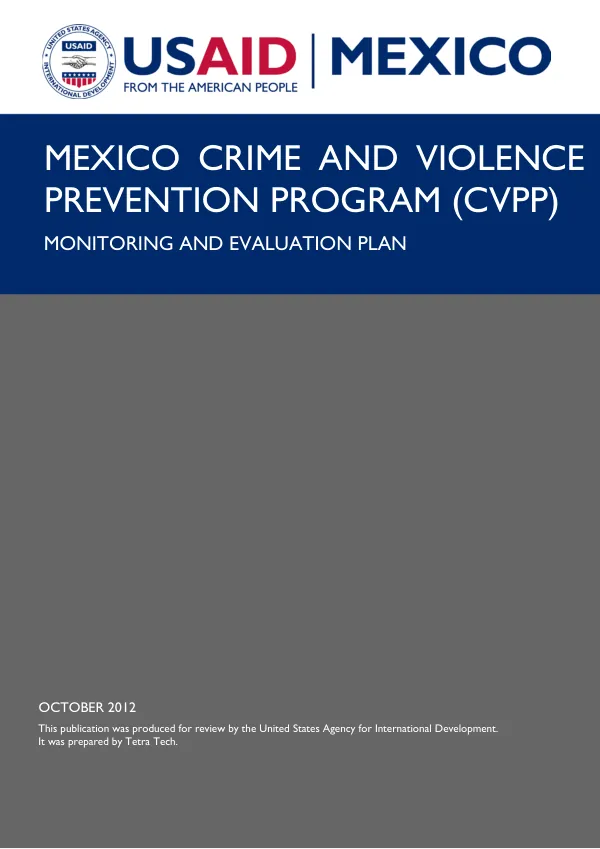
Mexico Crime and Violence Prevention Program (CVPP) Monitoring and Evaluation Report
Sign inGOVERNMENT OF MEXICO
Mexico Crime and Violence Prevention Program (CVPP) Monitoring and Evaluation Report
The Mexico Crime and Violence Prevention Program (CVPP) is a comprehensive initiative aimed at reducing crime and violence in Mexico.
2012 · 21 pages
Sign in to readA free account is required to download.
Abstract
The program is being implemented under USAID Contract No. AID-523-TO-12-00001, with Tetra Tech as the implementing partner. The CVPP is focused on building strong and resilient communities that can withstand the pressures of crime and violence. The program's progress is being monitored and evaluated through a Performance Monitoring Matrix, which was approved by USAID on June 11, 2012. The report covers eight months of program implementation, from early February through September 2012, during which start-up activities took place, including hiring and training staff, acquiring legal status in Mexico, establishing offices across four distinct geographic locations, and initiating relationships with the Government of Mexico (GOM). Significant progress has been made in supporting the achievement of the stated M&E targets. One of the program's most significant achievements in FY12 is the completion of nine Master Plans, one for each target city and its respective polígonos, through a highly participatory process. Additionally, 14 best practices in crime and violence prevention have been identified for documentation and subsequent replication. The program has also applied the Institutional Capacity Index (ICAPI) in the municipal governments of Tijuana and Monterrey, leading to concrete results. Furthermore, the CVPP has supported the development of a model for social programs and policies for crime and violence prevention in urban areas, which has been replicated in several communities. The program's progress is being measured through a set of indicators, including the percent of target populations that consider their community unsafe, the percent of citizens who perceive their communities to be "healthy" based on an aggregate scale of key factors for community health, and the number of crime prevention policies adopted by the Pillar IV Working Group and implemented by GOM agencies. The CVPP has also made significant progress in strengthening the capacity of state and local governments to implement crime prevention/reduction initiatives. This includes the development of crime prevention plans in target communities, the promotion of community policing to improve relationships between municipal police and communities, and the support of mechanisms to disrupt the path for youth to criminality. The program's achievements in FY12 demonstrate its commitment to reducing crime and violence in Mexico. The CVPP's progress is being closely monitored and evaluated to ensure that it is meeting its stated targets and making a positive impact on the communities it serves.