USAID. MISSION TO EGYPT
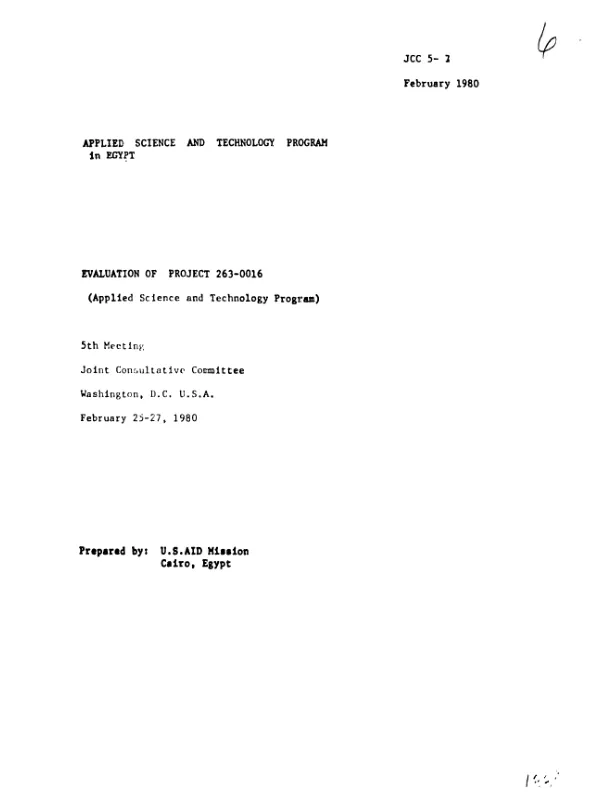
Applied science and technology program in Egypt, evaluation of project 263-0016
Evaluates project to upgrade the Government of Egypt"s (GOE) institutional capacity to conduct scientific and technological research in priority development areas.
1980
Sign in to readA free account is required to download.
Abstract
Initial PES covers the period 3/79-2/80; no methodology is given. Although delays due to lengthy contract negotiations have required a 1-year project extension and a revised implementation schedule, progress has been significant. The first major contractor, the National Academy of Science (NAS), has provided TA for the planning and coordination of research projects and has helped form a Joint Consultative Committee (JCC) which has facilitated program policy decisions between the GOE and USAID/E, set program goals, and reviewed research results. NAS has also placed a resident advisor at the National Research Center, but has yet to place one at the Academy of Scientific Research and Technology (ARST). Technical and management training conducted under the contract in the United States (43 students) and Cairo (200 students) has exceeded planned levels. TA has been provided for demonstration projects in the areas of cropping systems, varietal research, and biogas technology, as well as for R&D projects in phosphate ore evaluation, wool wax utilization, the causes and control of corrosion, and Red Sea fisheries. The JCC has begun to plan Phase II programs and subsequent follow-up activities. The second main contractor, the National Science Foundation (NSF), has provided TA to create a Science and Technology Information (STI) service; a Steering Committee under the aegis of the National Information and Documentation Center (NIDOC) has been formed to oversee STI activities. NSF has also installed a telex system at ARST to provide rapid access to STI data bases; purchased 5 microfiche readers for NIDOC, established a $10,000 core account at the U.S. National Technical Information Service for the purchase of microfiche, and provided NIDOC with a printed index of 2,500 NSF publications and with 30 basic references in information science and technology. Also, half of the scheduled $2.1 million in core scientific equipment has arrived, university students have been trained in basic electronics (141 students) and equipment maintenance and repair (4 students), and a training workshop in information systems and abstracting and indexing is planned.
Related documents