USAID DEC
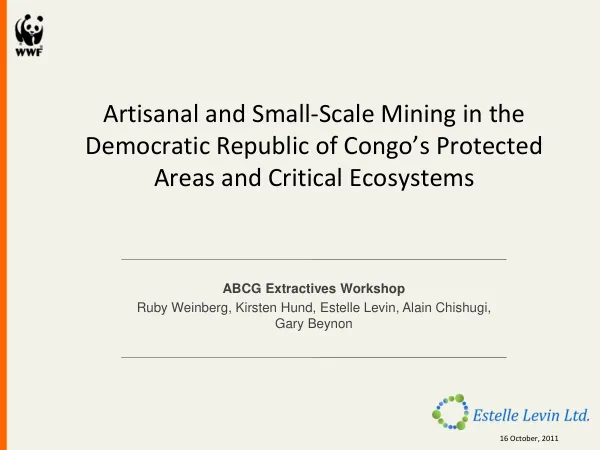
Artisanal and Small-Scale Mining in the Democratic Republic of Congo’s Protected Areas and Critical Ecosystems
Sign inWWF
Artisanal and Small-Scale Mining in the Democratic Republic of Congo’s Protected Areas and Critical Ecosystems
The ASM-PACE Programme aims to address the environmental impacts of Artisanal and Small-Scale Mining (ASM) in the Democratic Republic of Congo's protected areas and critical ecosystems.
2011 · 27 pages
Sign in to readA free account is required to download.
Abstract
This initiative is a collaboration between WWF and Estelle Levin Ltd. The programme's research focuses on artisanal mining and biodiversity in the DRC. Artisanal mining is a significant sector in the DRC, with approximately 10 million people, or 16% of the population, either directly involved in mining or dependent on it for their livelihood. The number of people seeking to work in this sector is expected to rise dramatically over the next ten years. The DRC is rich in mineral resources, including gold, diamonds, cassiterite, coltan, tin, tantalum, copper, and cobalt. Existing initiatives to regulate ASM in the DRC include the US Congress' Dodd Frank Act, the OECD Due Diligence Guidance, and the ITRI Ltd and T.I.C.'s Tin Supply Chain Initiative (iTSCi). Donor prioritization of formalization and regularization of the ASM sector is also underway, with projects such as the DFID & WB PROMINES Project and the International Task Force (ITF). However, these initiatives lack a strong conservation component. Artisanal mining takes place in approximately 40% of the DRC's protected areas, despite being illegal. The Kahuzi-Biega National Park (KBNP) and the Itombwe Nature Reserve (RNI) are two such areas. The KBNP, founded in 1970 and extended in 1975, is a UNESCO World Heritage Site and boasts a wide array of dense primary tropical forests, montane forests, and bamboo galleries. The park is inhabited by various groups of people, including farmers, indigenous groups, displaced groups, armed groups, hunters, rebels, stockbreeders, and miners. The KBNP is a contested conservation space, with human presence and activities affecting the park's ecosystem. The park's high mountains, including Mount Kahuzi (3,308m) and Mount Biéga (2,790m), are connected by a corridor to the lower altitude tropical forests of the west. The park is home to great apes and forest elephants, among other species. Research on ASM in the DRC aims to better understand the scale and nature of ASM in and around protected areas, identify its characteristics and impacts, and identify lessons learned from prior efforts to tackle challenges and build on opportunities associated with ASM in critical ecosystems. The research focuses on the KBNP and the RNI, using a desk-based review and interviews with key stakeholders on the ground.
Related documents