MCSP
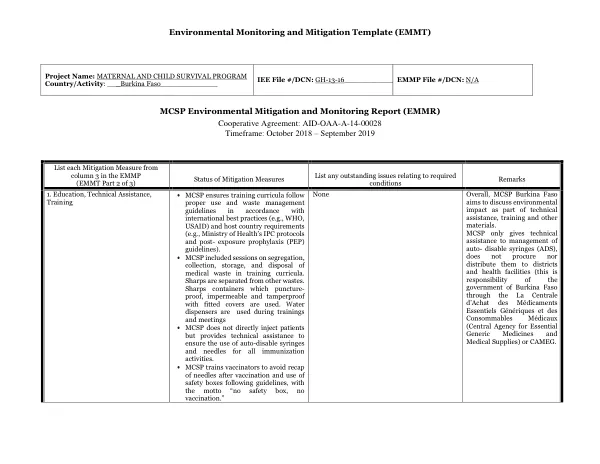
Environmental Monitoring and Mitigation Template (EMMT)
The Maternal and Child Survival Program (MCSP) implemented environmental mitigation measures in various countries, including Burkina Faso, Burma, and the Democratic Republic of Congo (DRC).
2019 · 66 pages
Sign in to readA free account is required to download.
Abstract
The program aimed to minimize its environmental impact through education, technical assistance, training, and other interventions. In Burkina Faso, MCSP ensured that training curricula followed proper use and waste management guidelines in accordance with international best practices and host country requirements. The program included sessions on segregation, collection, storage, and disposal of medical waste in training curricula. Sharps were separated from other wastes, and puncture-proof, impermeable, and tamper-proof sharps containers with fitted covers were used. Water dispensers were used during trainings and meetings. In Burma, MCSP supported the continued implementation of Quality Improvement (QI) activities at Sittwe General Hospital (SGH) in Rakhine State. The program provided continuous on-site technical support to facility staff in implementing QI activities, including facilitating hands-on practice on instrument processing and autoclaving. MCSP also finalized treatment flow charts for managing obstetric emergency cases and developed case scenarios of common obstetrics cases admitted to SGH. In the DRC, MCSP trained all healthcare providers of 106 healthcare facilities (HCFs) supported by the program in prevention of environmental impact related to family planning, child health, and WASH during the fiscal year October 2016-September 2017. The program ensured that all mitigation measures were implemented in all supported intervention sites, and practices were in compliance with the IPC and PEP policies and guidelines in all 106 HCFs and 119 community care sites. MCSP also developed an Environmental Mitigation and Monitoring Plan (EMMP) checklist, which was shared with the provincial health division (DPS) and health zone (HZ) teams. This checklist contains all environmental compliance parameters to be monitored in HCFs supported by MCSP. In addition, the program promoted increased surveillance of the hygienic burial of hazardous waste in collaboration with HZ teams. The program's environmental mitigation measures included proper waste segregation and disposal, use of safety boxes for disposal of sharps, needles, syringes, RDTs, and related materials, and handouts on medical waste and environmental management attached to family planning and child health training modules. MCSP also provided personal protective equipment (PPE) and training to all cleaners and waste managers in 35 HCFs supported by the program to pilot the WASH Clean Clinic Approach (CCA). Overall, MCSP's environmental mitigation measures aimed to minimize the program's environmental impact and promote a safe and healthy environment for healthcare providers and patients.