ASSOCIATES FOR INTERNATIONAL RESOURCES AND DEVELOPMENT (AIRD)
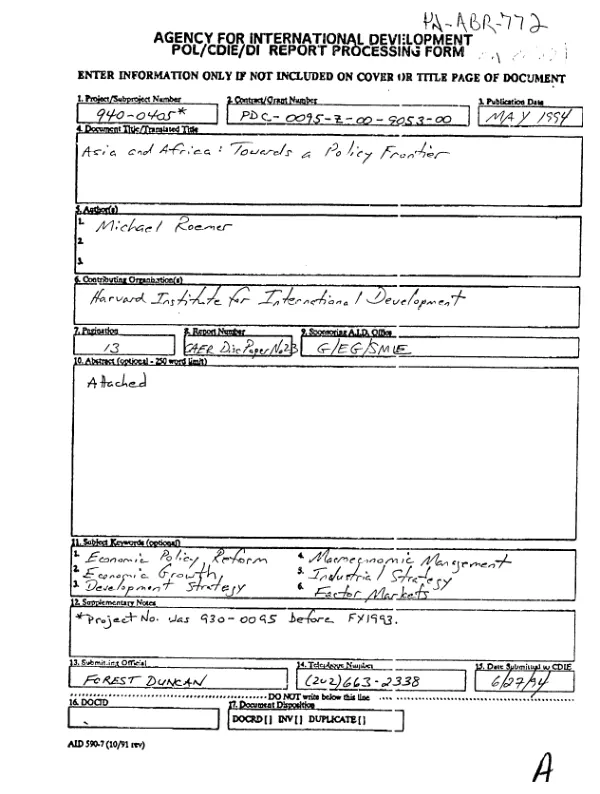
Asia and Africa : towards a policy frontier
The unprecedented economic growth of East Asian (South Korea, Taiwan, Hong Kong, and Singapore) and Southeast Asian (Indonesia, Malaysia, and Thailand) countries since 1965 has been proposed as a model for other developing countries, particularly in Africa.
Roemer, Michael · 1994
Sign in to readA free account is required to download.
Abstract
This paper summarizes, with the help of tables and charts, the key findings of a recent book, "Asia and Africa: Legacies and Opportunities in Development", which detailed important differences between the economic policies of Asian and African countries. The Asian countries" economic policies are examined under three categories -- governance and economic strategy, factor endowments, and development strategy -- with emphasis on the third, which includes macroeconomic management, industrial strategy, and flexible factor markets (labor and credit) components. The paper concludes that while there is no single Asian model of development, there are four common elements in the economic policies of all seven rapidly growing Asian economies: (1) exchange rates were managed to provide constant and rewarding incentives to exporters; (2) budget deficits were kept small in relation to national income; (3) economies were outward-looking, in the sense that exporters had access to inputs and could sell their outputs at close to world market prices, despite protection for domestically oriented industries; and (4) labor and credit markets were kept flexible enough to direct resources to the most rapidly growing industries. The paper suggests that African countries have fallen short in these crucial respects, and predicts that it will take several years before reforms generate growth in African countries, where poor policies have prevailed for up to two decades, and where determined reforms have not yet begun. Includes the table of contents from the full publication. (Author abstract, modified)
![Foreign exchange liberalization and it"s [its] impact on economic growth and stability of the Egyptian economy : a case study](https://covers.devme.ai/gen/68224.webp)