DEVELOPMENT ASSOCIATES, INC.
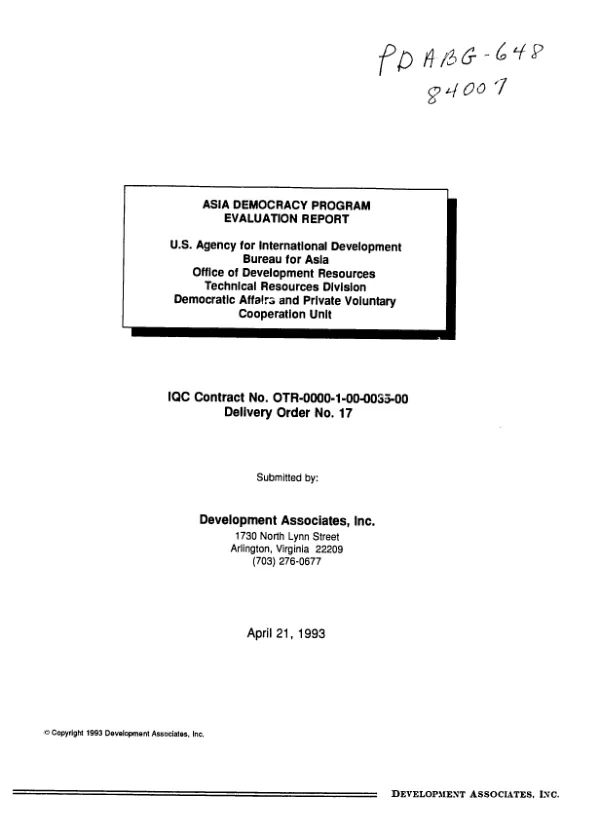
ASIA democracy program : evaluation report
Evaluates the Asia Democracy Program (ADP) and related activities of USAID Missions in Thailand, Nepal, Sri Lanka, and the Philippines.
1993
Sign in to readA free account is required to download.
Abstract
The evaluation reviews 43 completed and ongoing projects funded under human rights directives, Mission-funded PVO Co-financing and Democratic Pluralism Initiatives, and more recently the ADP. Evaluation covers the period through 11/92. Overall, the ADP is well designed and implemented and in the long run is likely to achieve its aim. Success will depend heavily upon political stability in the four nations in the coming years; most interviewees expressed optimism in this regard. Most program funds have been channeled to indigenous NGOs, either directly through the Missions or through U.S. PVOs, primarily the Asia Foundation, the Asian-American Free Labor Institute (AAFLI), and Private Agencies Collaborating Together. All the Missions place great emphasis on the role of NGOs in democratization. It is difficult to quantify the impact of the various projects; most are less than 18 months old, baseline and impact data are scarce, and many of the projects are small and short-term in nature. However, there were many specific examples of accomplishment. (1) A voter education program in selected hill districts of Nepal helped increase voter turnout for the 1991 elections by at least 25%. (2) A Thai labor lawyer avowed that participation in AAFLI leadership training workshops had improved his case win percentage to 70%. (3) The Sri Lanka Bar Association conducted seminars for 350 lawyers on recent developments in domestic and international human rights litigation. (4) A campaign by FREELAVA, a Filipino NGO receiving ADP support, to publicize the plight of inmates in jails in Cebu, many of whom had not been charged with any specific crimes, led to prison cleanup and faster progress of cases through the courts. While the Missions had significant leeway in generating their own priorities, certain common areas of activity emerged, indicating consensus about how to achieve ADP objectives. In light of these similarities, it is recommended that Asia Bureau reformulate its democratization strategy to cluster these activity areas around a new set of initiatives: (1) civil society -- participatory development groups, advocacy NGOs, government accountability, and trade unions; (2) governance -- public administration, national legislatures, local government strengthening, institutional accountability and transparency, and electoral support; (3) rule of law -- legal awareness, judicial independence, administration of justice, informal dispute resolution, and human rights; and (4) information -- public policy reporting, citizen access, independent media, and journalistic accountability. Lessons learned were as follows. (1) For ADP to have maximum impact, there needs to be an integrated effort among the U.S. State Department, USAID, and the U.S. Information Service, along with the pertinent NGOs, to devise a collaborative program; the Nepal program is an excellent example of such an effort. (2) Projects that enhance constitutional structures can strengthen democratic processes. (3) Projects funded by bilateral agencies are more likely to succeed if implemented by an indigenous NGO, particularly in sensitive areas such as judicial, administrative, or structural reform. Too much preoccupation with promoting the U.S. role in democratization could produce a backlash in the long run. (4) No single strategy for democratization is suitable for all countries, or even for a group of neighboring countries; project specifics must be designed by experienced area specialists. (5) NGOs have a vital role to play in instigating political change, especially in the area of decentralization advocacy; democratization and NGO development are inextricably linked.