USAID DEC
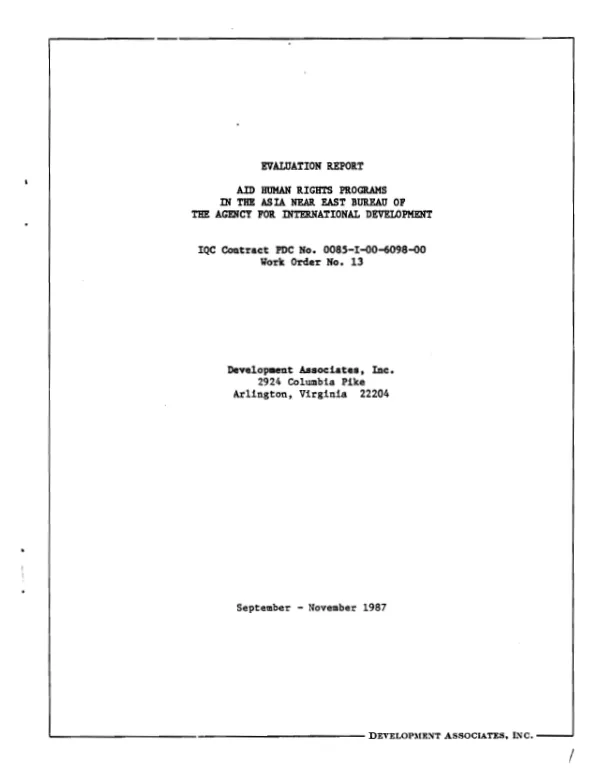
Evaluation report : AID human rights programs in the Asia Near East Bureau of the Agency for International Development
Sign inDEVELOPMENT ASSOCIATES, INC.
Evaluation report : AID human rights programs in the Asia Near East Bureau of the Agency for International Development
Evaluates human rights activities in Nepal, the Philippines, Thailand, Indonesia, Morocco, Egypt, and Jordan.
1987
Sign in to readA free account is required to download.
Abstract
External evaluation covers FY79-9/87. Of 26 activities reviewed, 19 have successfully achieved project purposes and the remaining 7 have partially or mostly done so. Most projects were well-designed, with inputs delivered adequately. Although an actual impact assessment is not possible due to lack of baseline data and sophisticated sampling methods, it appears that legal representation/counseling services have had the most immediate impact, while legal literacy and outreach programs through mass media have reached the most people. As yet there is no evidence of impacts at the national level. By themselves, the activities are too small to have any effect at the national level, and there is insufficient networking among activities to make a country program truly national. In Asia, A.I.D. directly manages human rights activities in Nepal. These activities are well-managed and generally on schedule. The Nepal Women's Legal Services subproject has exceeded targets and positively affected thousands of women. In the other 3 Asian countries, The Asia Foundation (TAF) has successfully managed activities involving research, seminars, institutional support, training materials, and legal assistance/education. Only in Indonesia have activities been impeded by internal problems among local institutions. TAF country staffs are small but knowledgeable in local languages, culture, and human rights. Activities in the Near East - implemented by America-Mideast Education and Training Services, Inc. (AMIDEAST) - include training law faculties and judges, study tours, books, seminars, research support, and TA. Law faculty training at the International Institute of Human Rights in Strasbourg was the most effective activity; participants carried out several follow-on activities. Successful seminars were also conducted in Morocco and in Jordan, while others, such as one at Zagazig University, Egypt, although less effective, nevertheless provided a forum for human rights discussion. Research projects in the Middle East are rated low, on a par with similar projects in Asia. There is also a need for projects to assist national legislatures and develop Arabic-language training and translation facilities. Several lessons were learned. (1) Projects strengthening legal systems also strengthen human rights enforcement. (2) Human rights activities should be mutually supporting and interdependent. (3) Program designers and implementers should be sensitive to language requirements of participants. (4) Human rights changes are more likely to result from political events, but the possibility of long-term impacts should not be discounted. (5) These activities, though small, give Missions an opportunity to include human rights in policy dialogue.
Related documents
![Evaluation of the US-Asia environmental partnership [US-AEP]](https://covers.devme.ai/gen/5422.webp)