USAID DEC
Assessing fish diversity in abandoned mining ponds in Madre de Dios, Peru, using environmental DNA
Sign inUSAID DEC
Assessing fish diversity in abandoned mining ponds in Madre de Dios, Peru, using environmental DNA
The Peruvian region of Madre de Dios is a biodiversity hotspot located in the Andean-Amazon region.
2024 · 17 pages
Sign in to readA free account is required to download.
Abstract
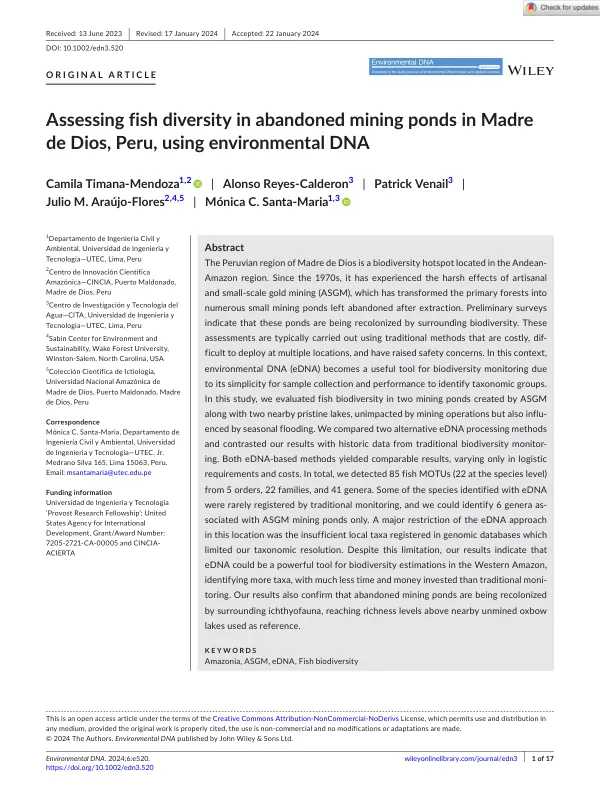
It has been severely impacted by artisanal and small-scale gold mining (ASGM), which has transformed the primary forests into numerous small mining ponds left abandoned after extraction. Preliminary surveys indicate that these ponds are being recolonized by surrounding biodiversity. Environmental DNA (eDNA) becomes a useful tool for biodiversity monitoring due to its simplicity for sample collection and performance to identify taxonomic groups. In this study, fish biodiversity in two mining ponds created by ASGM was evaluated, along with two nearby pristine lakes, unimpacted by mining operations but also influenced by seasonal flooding. Two alternative eDNA processing methods were compared, and the results were contrasted with historic data from traditional biodiversity monitoring. Both eDNA-based methods yielded comparable results, varying only in logistic requirements and costs. In total, 85 fish MOTUs (22 at the species level) from 5 orders, 22 families, and 41 genera were detected. Some of the species identified with eDNA were rarely registered by traditional monitoring, and 6 genera associated with ASGM mining ponds only were identified. A major restriction of the eDNA approach in this location was the insufficient local taxa registered in genomic databases, which limited taxonomic resolution. Despite this limitation, the results indicate that eDNA could be a powerful tool for biodiversity estimations in the Western Amazon, identifying more taxa with much less time and money invested than traditional monitoring. The Madre de Dios region is home to a rich biodiversity of freshwater fish, with up to 533 species reported to date. However, the region has been severely impacted by ASGM, resulting in the loss of nearly 120,000 ha of forests between 1984 and 2021. The landscape has been dramatically transformed from tropical forest to thousands of small artificial mining ponds, abandoned after mining activities or due to government intervention. Recent research indicates that local aquatic communities have started to recolonize these artificial ecosystems after receiving a pool of individuals and nutrient inputs when influenced by periodic flooding by surrounding rivers. Biodiversity monitoring of fish fauna in the Madre de Dios area is being done using traditional methods, aligned with the Peruvian Environmental Authority monitoring guidelines. These involve the capture of fish followed by morphological studies to identify individual species, to then derive community-wide indicators, such as species richness and relative abundance. While effective, this approach is people and time intensive and requires considerable logistic resources, hindering extensive monitoring. In contrast to traditional methods, eDNA is an alternative approach for sustained biodiversity monitoring that has shown increasing success.
Related documents
Documents in this collection
 2016
2016USAID DEC
Cryptic, Sympatric Diversity in Tegu Lizards of the Tupinambis teguixin Group (Squamata, Sauria, Teiidae) and the Description of Three New Species
Open record 2024
2024USAID DEC