USAID DEC
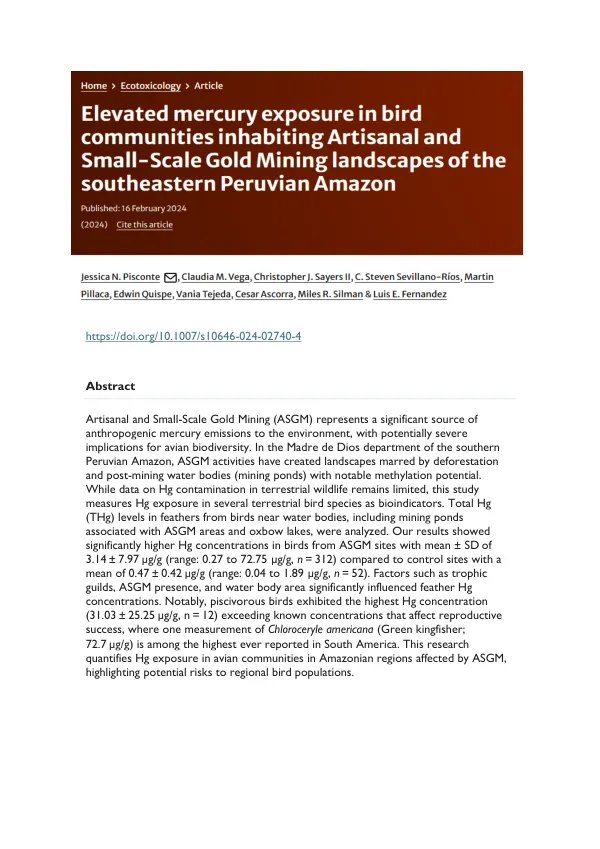
Mercury Exposure in Avian Communities in Amazonian Regions Affected by Artisanal and Small-Scale Gold Mining
Sign inUSAID DEC
Mercury Exposure in Avian Communities in Amazonian Regions Affected by Artisanal and Small-Scale Gold Mining
Artisanal and Small-Scale Gold Mining (ASGM) activities in the Madre de Dios department of the southern Peruvian Amazon have significant implications for avian biodiversity due to anthropogenic mercury emissions.
2024 · 1 pages
Sign in to readA free account is required to download.
Abstract
The region's landscapes are marred by deforestation and post-mining water bodies, known as mining ponds, which have notable methylation potential. These areas pose a risk to terrestrial wildlife, including birds. Total mercury (THg) levels in feathers from birds near water bodies, including mining ponds associated with ASGM areas and oxbow lakes, were analyzed. The results showed significantly higher Hg concentrations in birds from ASGM sites compared to control sites. Birds from ASGM sites had a mean THg level of 3.14 ± 7.97 µg/g, with a range of 0.27 to 72.75 µg/g, based on 312 samples. In contrast, control sites had a mean THg level of 0.47 ± 0.42 µg/g, with a range of 0.04 to 1.89 µg/g, based on 52 samples. Factors such as trophic guilds, ASGM presence, and water body area significantly influenced feather Hg concentrations. Piscivorous birds, which feed on fish, exhibited the highest Hg concentration, with a mean of 31.03 ± 25.25 µg/g, based on 12 samples. This level exceeds known concentrations that affect reproductive success. Notably, one measurement of Chloroceryle americana (Green kingfisher) was 72.7 µg/g, which is among the highest ever reported in South America. The research highlights potential risks to regional bird populations due to Hg exposure in avian communities in Amazonian regions affected by ASGM. The findings emphasize the need for further investigation into the impacts of ASGM on avian biodiversity and the development of strategies to mitigate these effects. The study's results have significant implications for the conservation of avian populations in the region. The high levels of Hg exposure in birds from ASGM sites suggest that these areas pose a significant threat to regional bird populations. The findings also highlight the importance of considering the impacts of ASGM on avian biodiversity in conservation efforts.
Related documents