USAID DEC
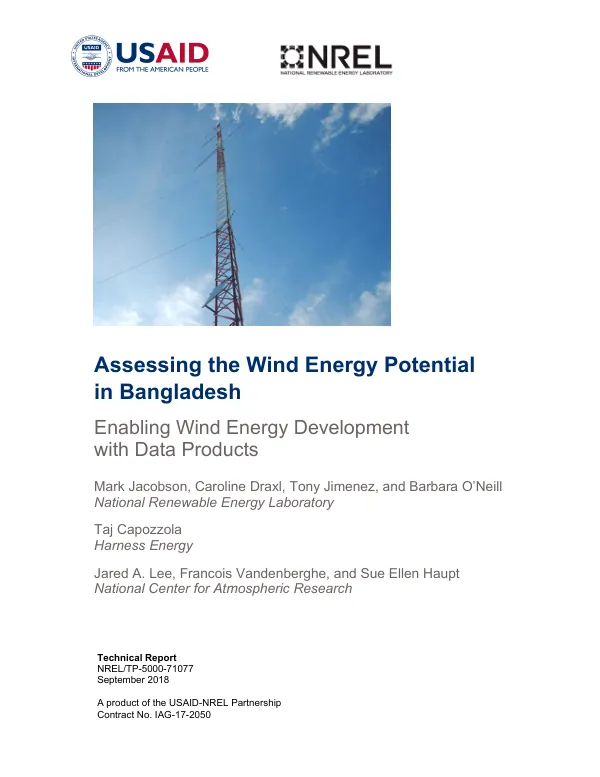
Assessing the Wind Energy Potential in Bangladesh: Enabling Wind Energy Development with Data Products
Sign inGOVERNMENT OF BANGLADESH
Assessing the Wind Energy Potential in Bangladesh: Enabling Wind Energy Development with Data Products
The Bangladesh wind energy potential assessment was conducted by the National Renewable Energy Laboratory (NREL) in partnership with the Government of Bangladesh and the United States Agency for International Development (USAID).
2018 · 136 pages
Sign in to readA free account is required to download.
Abstract
The project aimed to develop a national wind resource assessment using sophisticated resource modeling validated by a ground measurement campaign. The assessment used a multi-year, local data-collection campaign to validate the model and improve the accuracy of the data sets. The measurement campaign consisted of nine meteorological sites representing all geographical regions of the country. Seven meteorological towers and one remote-sensing, sonic detection and ranging unit (deployed at two sites) collected the data. Site-selection criteria focused on geographic diversity and proximity to existing transmission lines. The results of the Bangladesh wind resource assessment will help the country overcome significant energy challenges, including power shortages, increasing demand, decreasing domestic natural gas reserves, and inadequate transmission infrastructure. The assessment will provide high-quality renewable energy resource data and other geographic information system (GIS) data, which are essential for informed decision making, ranging from policy and investment decisions to reliable power sector planning. The project improved upon existing global data sets by using best-in-class modeling techniques and analysis. Global models are good first steps in predicting wind resources in various parts of the world, but they do not generate the accuracy needed to reduce project risk and stimulate renewable investment. This project improved the quality of modeled wind resource data for Bangladesh. The assessment will help reduce technical risk and encourage private-sector interest in the nascent wind market in Bangladesh. The Government of Bangladesh may use the results of the wind resource assessment to develop well-designed policies that could encourage investment in wind energy. The report provides a comprehensive description of the Bangladesh wind resource assessment, including details on the modeling approach and methods, instrumentation, data quality-control techniques, and resulting data sets. The wind resource assessment used a combination of modeling and measurement techniques to estimate the wind energy potential in Bangladesh. The modeling approach used a high-resolution wind resource model, which was validated by the measurement campaign. The measurement campaign consisted of nine meteorological sites, which collected data on wind speed, direction, and other relevant parameters. The assessment results include a long-term, correlated wind data set; validated high-resolution wind resource maps; and publicly available data accessible through the Renewable Energy (RE) Data Explorer. The RE Data Explorer allows users to access and download the Bangladesh wind resource assessment data and related GIS data sets and perform customized technical potential analyses. The project team used a multi-step approach to select the measurement sites, including desktop analysis, micrositing, and land lease. The team also established landowner/community relationships to ensure successful implementation of the measurement equipment. The instrumentation used in the measurement campaign included meteorological towers and remote-sensing, sonic detection and ranging units. The assessment results will provide valuable information for policymakers, investors, and other stakeholders interested in developing wind energy projects in Bangladesh. The results will help reduce technical risk and encourage private-sector interest in the nascent wind market in Bangladesh. The Government of Bangladesh may use the results of the wind resource assessment to develop well-designed policies that could encourage investment in wind energy.
Related documents