GEORGIA NATIONAL ELECTRICITY AND WATER SUPPLY REGULATORY COMMISSION
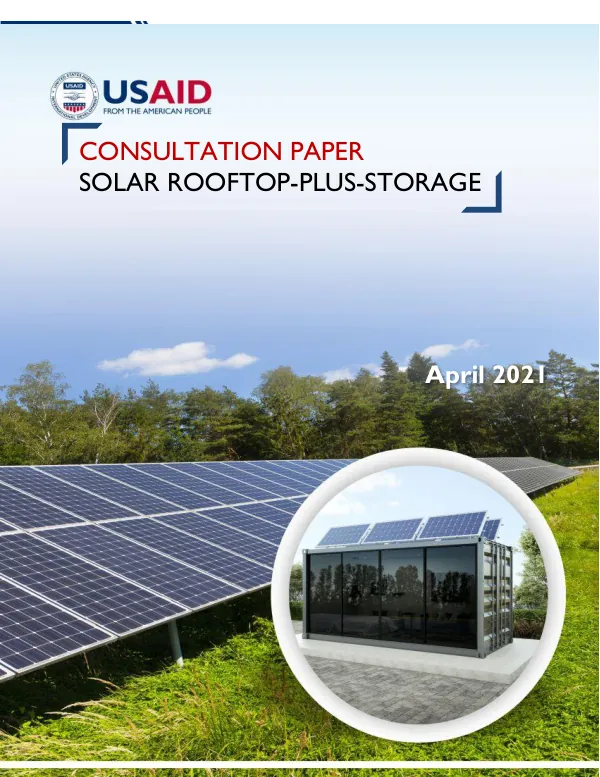
Consultation Paper on Enabling Consumer Sited Solar-plus-Storage
The Indian power sector is in transition as the country aims to add 175 GW of renewable energy capacity by 2022 and scale this up further to 450 GW by 2030.
2021 · 32 pages
Sign in to readA free account is required to download.
Abstract
This target is expected to result in 40 percent of India's total installed capacity coming from non-fossil fuel energy sources by 2030. The National Solar Mission has set a target of 60 GW of utility-scale solar and 40 GW of distributed solar by 2022, with the Ministry of New and Renewable Energy developing state-specific targets. Rooftop solar deployment has been slow in the early years of the market, but as India works to meet its targets, the increased solar supply will modify supply and net load curves, leading to grid management issues. The modified net load curve with additional solar deployment will create variations of the duck curve, which can be addressed by pairing rooftop solar with energy storage, along with well-designed rate structures to align utility and consumer value. India's regulatory frameworks and established DISCOM programs and practices can be an impediment to achieving rooftop solar deployment goals. Many DISCOMs in India are expressing concerns over revenue sufficiency, fixed cost recovery, cross-subsidization, grid integration challenges, and other perceived issues related to distributed solar PV. The Forum of Regulator's 2013 Model Net Metering Regulations and the Forum of Regulator's Draft Model Regulation for Grid Interactive Distributed Renewable Energy Sources in 2018-19 have been proposed to address these concerns. Gujarat has high solar PV and wind renewable energy targets, based on forecasted energy demand, with good underlying resources and siting availability in many parts of the state. The state has a total annual energy demand and peak demand of 98 GWh and 15 GW, respectively. Net energy metering is the primary compensation mechanism for rooftop solar exports in Gujarat, although the state has recently created a net billing scheme as an alternative to its net energy metering scheme. Enabling consumer-sited energy storage is important as it can provide a number of services to both the consumer and the grid. For consumers, allowing the interconnection of storage systems with rooftop solar can potentially provide additional value in terms of bill savings, improved power quality, and additional resilience and reliability benefits. For the electric grid, storage can allow for higher levels of solar integration, improved grid stability, and reduced peak demand. The Gujarat Solar Power Policy 2021 introduces changes that impact the economic viability for solar-plus-storage for some consumers. The policy aims to promote the development of solar power in the state, while also addressing the concerns of DISCOMs. The policy includes provisions for net billing, which rewards consumers for injecting excess energy into the grid, and also provides for the installation of energy storage systems to stabilize the grid. The Partnership to Advance Clean Energy-Deployment (PACE-D 2.0 RE) Technical Assistance Program, funded by the United States Agency for International Development (USAID), has prepared a consultation paper on enabling consumer-sited solar-plus-storage. The paper aims to provide a comprehensive analysis of the regulatory framework for rooftop solar and energy storage in Gujarat, and to identify solutions to address the challenges faced by DISCOMs and consumers. The paper highlights the importance of enabling consumer-sited energy storage in Gujarat, which can provide a number of benefits to both consumers and the grid. The paper also identifies the key regulatory issues for consumer-sited solar-plus-storage interconnection in Gujarat, and provides solutions to consider based on global best practices. The paper concludes by emphasizing the need for a well-designed regulatory framework that balances the interests of DISCOMs, consumers, and the grid.