USAID DEC
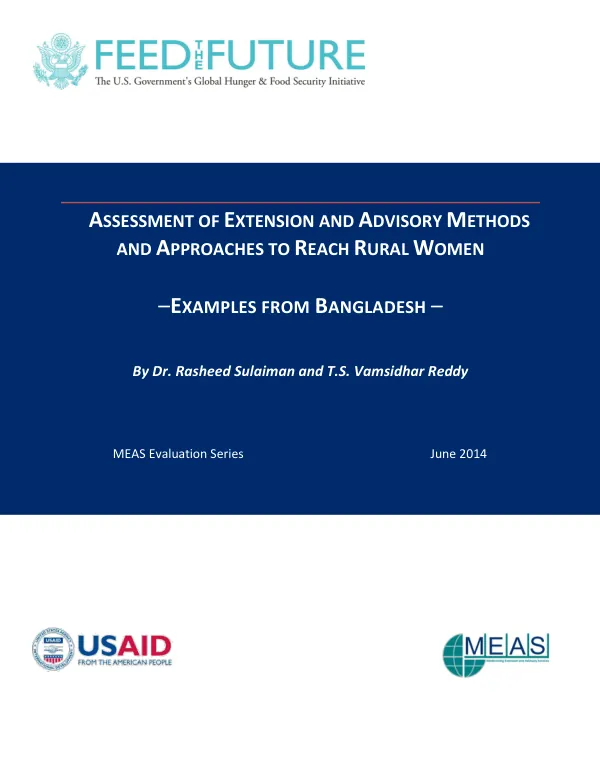
Assessment of Extension and Advisory Methods and Approaches to Reach Rural Women – Examples from Bangladesh
Sign inBRAC INTERNATIONAL
Assessment of Extension and Advisory Methods and Approaches to Reach Rural Women – Examples from Bangladesh
Agricultural extension and advisory services play a crucial role in promoting agricultural development and improving the livelihoods of rural communities, particularly women.
2014 · 44 pages
Sign in to readA free account is required to download.
Abstract
In Bangladesh, various extension methods and approaches have been employed to reach rural women farmers. A systematic review of peer-reviewed literature reveals that holistic approaches such as villages, groups, whole family training, and farmer field schools (FFS) are being used to reach women farmers. However, the literature is limited, and most studies focus on group approaches such as FFS, thrift and credit, and the use of information and communication technologies (ICTs). The systematic review of grey literature highlights three types of extension approaches being used in Bangladesh: FFS, Training and Visit (T&V), and ICTs. While FFS is widely used, there is a need to modify this approach to reach rural women. Factors for the success of FFS include appropriate training and monitoring of FFS facilitators, as well as synchronizing activities with the cropping season. The T&V system faces constraints such as lack of resources, poor flow of information, poor monitoring system, weak attempts at developing capacities of staff, and frequent transfers. Case studies conducted in Bangladesh provide evidence on the impact, scale-in-use, and benefits to women of selected extension and advisory services. The creation of strong social organizations is central to reaching rural women, and approaches such as union federations and groups like FFS for training and building entrepreneurial skills are effective. ICTs also have the potential to reach rural women. However, reaching rural women effectively requires long-term presence, commitment in terms of human and financial resources, and the engagement of a number of stakeholders. The review highlights the importance of addressing gender inequality and the need to make women's work visible in the development process. From a gender perspective, making women's work visible is significant to achieving family cooperation by working with whole family approaches. The review also emphasizes the need to address culture and local context in extension processes. The findings of this review have implications for the design and implementation of extension and advisory services in Bangladesh, particularly in terms of reaching rural women farmers. The review identifies five approaches to reaching rural women in Bangladesh: creating a social infrastructure, value chain development, self-help groups (SHGs), ICTs, and women extension workers. These approaches have the potential to improve the livelihoods of rural women farmers and promote agricultural development in Bangladesh. However, the success of these approaches depends on the resources and ability of women farmers to adapt. The review highlights the need for long-term presence, commitment, and engagement of stakeholders to effectively reach rural women. The case studies conducted in Bangladesh provide evidence on the impact, scale-in-use, and benefits to women of selected extension and advisory services. The findings of the review have implications for the design and implementation of extension and advisory services in Bangladesh, particularly in terms of reaching rural women farmers. The review highlights the importance of addressing gender inequality and the need to make women's work visible in the development process.
Related documents