USAID
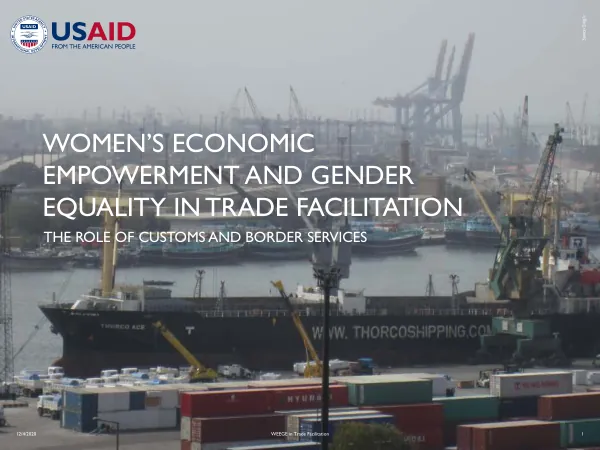
Women’s Economic Empowerment and Gender Equality in Trade Facilitation
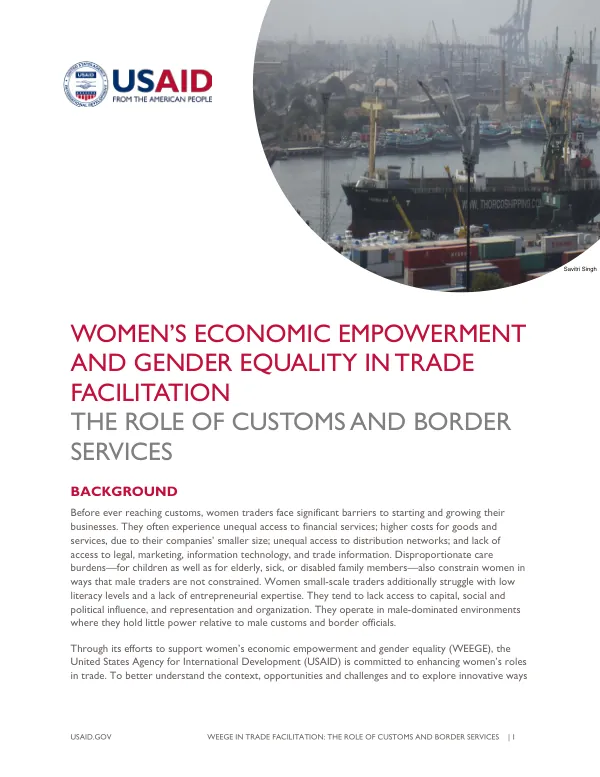
Women's Economic Empowerment and Gender Equality in Trade Facilitation is a critical area of focus, particularly at the border.
2020 · 24 pages
Sign in to readA free account is required to download.
Abstract
Customs and border services play a pivotal role in facilitating trade while enforcing laws and securing the homeland. However, women traders often face significant barriers, including lack of access to innovative trade facilitation technology, inadequate trade information, and limited market access. Customs services in many economies have dual and competing functions, which can hinder effective trade facilitation. In advanced economies, enhanced automation and trade facilitation have improved the efficiency of customs services. In contrast, many emerging economies struggle with limited automation, inadequate trade facilitation, and insufficient border infrastructure. This can lead to marginalization, hampering, and unrecognized status of small-scale women traders. Women traders operate in male-dominated environments, where they hold less power relative to male customs and border officials. This power imbalance can result in unequal treatment and limited access to trade opportunities. The needs of women traders are often not considered in trade initiatives, which can exacerbate existing challenges. For instance, border infrastructure may not meet the safety and physical needs of women traders, putting them at risk. Research has highlighted the significant gap between men and women engaged in trade. Women make up most of the small-scale traders globally, with more than 70% in Africa. Women traders, running companies of all sizes, face disproportionate family care burdens, which can hinder their ability to participate in trade. The lack of trade information is a major barrier for women traders, and they need access to innovative trade facilitation technology to compete effectively. Implementation of trade facilitation initiatives that prioritize women's economic empowerment and gender equality is essential. This can involve providing training and capacity-building programs for customs officials, enhancing automation and trade facilitation, and improving border infrastructure to meet the needs of women traders. By addressing these challenges, governments and international organizations can promote greater economic inclusion and opportunities for women traders.