USAID DEC
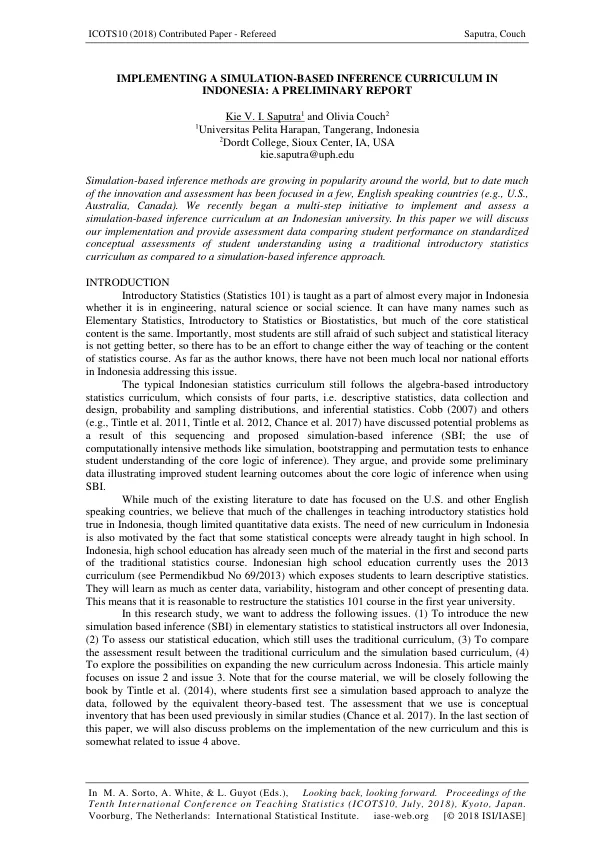
Assessment of statistical education in Indonesia: Preliminary results and initiation to simulation-based inference
Sign inUSAID DEC
Assessment of statistical education in Indonesia: Preliminary results and initiation to simulation-based inference
The traditional elementary statistics course in Indonesia follows the algebra-based introductory statistics course that has been implemented in a number of popular books.
2018 · 10 pages
Sign in to readA free account is required to download.
Abstract
These books tend to the same four parts, which are descriptive statistics, data and design, probability and distributions, and some knowledge of basic random variables, and basic inferential statistics. However, by the time students reach the pivotal point of this course, which is inferential statistics, they end up in "survival mode," memorizing formulas without really understanding the concepts of how to draw reliable conclusions from data. The American Statistics Association published the Guidelines for Assessment and Instruction in Statistical Education, also known as GAISE, in 2005. This guideline recommended developing statistical thinking, using real data, emphasizing statistical concepts rather than procedures, focusing on student active learning, using technology in analyzing data, and assessing to evaluate and improve the learning process. However, Cobb argued that this guide along with its recommendations is not enough and urged statistical educators to change the pedagogy and content of the elementary statistics course. The CAOS test, developed by Delmas in 2007, is a comprehensive assessment of student understanding in the elementary statistics course. This assessment was the first standard, comprehensive instrument for the introductory statistics course. The result of the CAOS test showed that students only gained an average of 9% difference, indicating that most students didn't really understand statistics. Other assessments, such as SATS and GOALS-2, have been successfully evaluated the impact of introductory statistics classes in US institutions. Tintle et al. developed a new pedagogy in teaching statistics, which is in line with the GAISE recommendation. They took a student active learning approach and completely re-ordered, re-emphasized, and added content to the traditional elementary statistical course. The result showed a strong evidence that the student average in the new pedagogy is higher than that in the current pedagogy. The simulation-based inference (SBI) curriculum has been developed as a new pedagogy in teaching statistics. This curriculum works better than the traditional curriculum, as shown by the analysis of multi-institution data. The SBI curriculum has been motivated by the fact that some statistical concepts are taught in high school, and the elementary statistics material taught in first-year college or first-year university needs to be reshaped. The traditional statistics course in Indonesia has several exceptions, such as the use of the z distribution to test the population mean if the number of samples is more than 30, and the use of the t distribution if the number of samples is less than 30. However, sometimes the population distribution is known normal, and the population standard deviation is known, so even if the number of samples is less than 30, the z distribution can be used to perform the test. The elementary statistics course in Indonesia has been taught in almost every department, whether it is in engineering faculty, social science faculty, or business school. However, the content of the course is conceptually the same, and the way of teaching is also the same. The fact that students in Indonesia are afraid of statistics courses indicates that the pedagogy and content of the course need to be changed. The development of the simulation-based inference (SBI) curriculum has been motivated by the need to change the pedagogy and content of the elementary statistics course. The SBI curriculum has been shown to work better than the traditional curriculum, and it has been motivated by the fact that some statistical concepts are taught in high school. The SBI curriculum has been developed to reshape the elementary statistics material taught in first-year college or first-year university. The elementary statistics course in Indonesia has been taught in almost every department, and the content of the course is conceptually the same. However, the way of teaching is also the same, and the students in Indonesia are afraid of statistics courses. The development of the simulation-based inference (SBI) curriculum has been motivated by the need to change the pedagogy and content of the course. The SBI curriculum has been shown to work better than the traditional curriculum, and it has been motivated by the fact that some statistical concepts are taught in high school.