USAID DEC
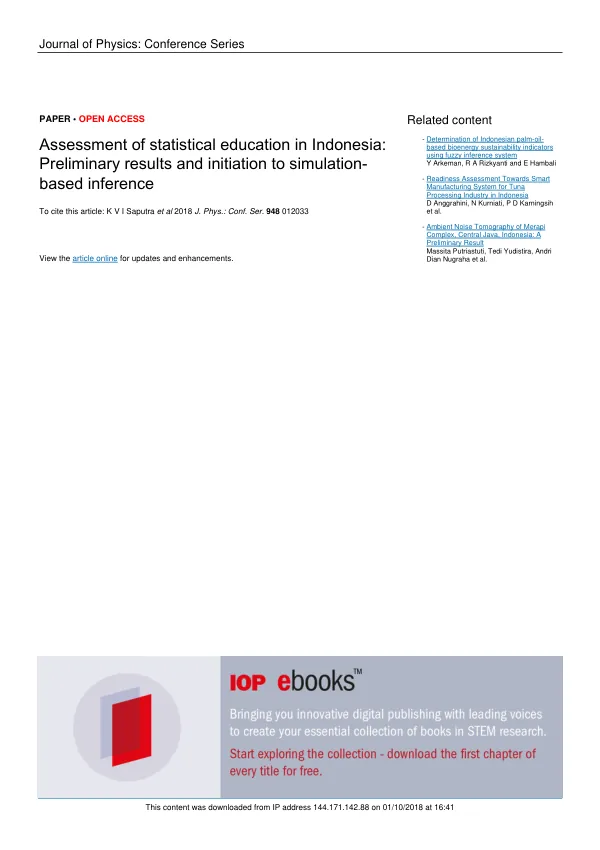
Implementing a Simulation-Based Inference Curriculum in Indonesia: A Preliminary Report
Sign inINTERNATIONAL STATISTICAL INSTITUTE
Implementing a Simulation-Based Inference Curriculum in Indonesia: A Preliminary Report
A simulation-based inference curriculum was implemented at an Indonesian university as part of a multi-step initiative to assess and improve student understanding of introductory statistics.
2018 · 4 pages
Sign in to readA free account is required to download.
Abstract
The traditional curriculum, which focuses on algebra-based methods, has been the standard in Indonesia, but it has been criticized for not effectively conveying the core logic of inference. Researchers sought to introduce a simulation-based inference (SBI) approach, which uses computationally intensive methods like simulation, bootstrapping, and permutation tests to enhance student understanding. The SBI approach was introduced in one section, while two other sections continued with the traditional curriculum. Students completed a 30-question conceptual inventory, which assessed their understanding of statistical concepts. The results showed that both SBI courses demonstrated significant improvement in student understanding, compared to only one of the three traditional courses. However, the gain for one of the traditional courses was substantial, with an 11.4% increase in scores. The data was stratified into three groups based on pre-test scores, and the results showed that SBI students outperformed traditional students in the lowest group, while the reverse was true for more typical students. Students who performed well on the pre-test showed no improvement in either curriculum. The estimated effect of the SBI curriculum relative to the traditional curriculum on change in scores was also examined, and the results showed that SBI students performed better in the lowest pre-test group, while traditional students performed better in the middle and highest pre-test groups. The study's findings suggest that the SBI approach may be effective in improving student understanding of introductory statistics, particularly for students who struggle with the traditional curriculum. However, the results also indicate that the traditional curriculum can be effective for students who are already performing well. The study's authors recommend further research to explore the possibilities of expanding the SBI curriculum across Indonesia. The implementation of the SBI curriculum was carried out over a three-semester period, across three instructors, and five class sections. The data was collected using a 30-question conceptual inventory, which was administered electronically in some sections and paper-administered in others. The results were analyzed using paired t-tests, and the estimated effect of the SBI curriculum relative to the traditional curriculum was examined using a linear model. The study's findings have implications for the teaching of introductory statistics in Indonesia and potentially in other countries. The results suggest that the SBI approach may be a valuable tool for improving student understanding of statistical concepts, particularly for students who struggle with the traditional curriculum. However, further research is needed to fully explore the potential of the SBI approach and to identify the most effective ways to implement it in different educational settings.
Related documents