CHEMONICS INTERNATIONAL, INC.
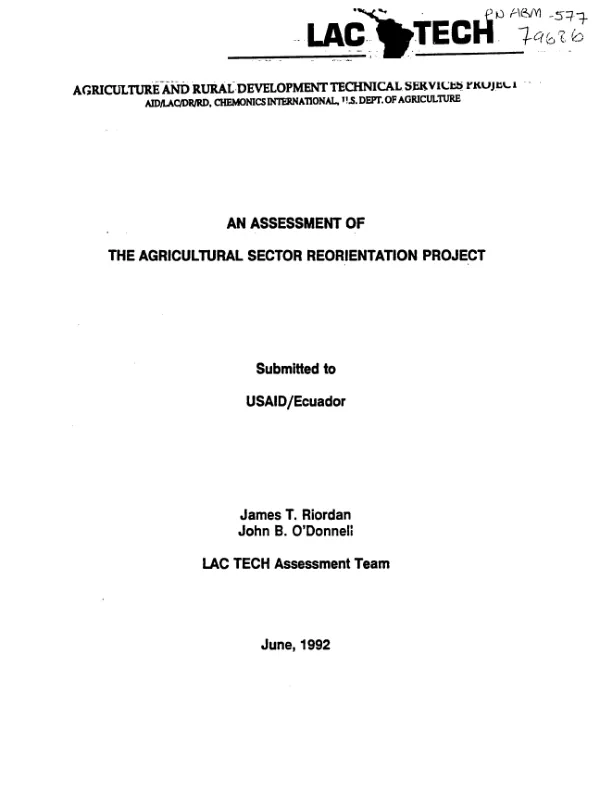
Assessment of the agricultural sector reorientation project
Evaluates project to reorient agricultural policy toward medium and small farm production in Ecuador.
Riordan, James T.|O'Donnell, John B. · 1992
Sign in to readA free account is required to download.
Abstract
The evaluation focuses on the period since 6/90, when the project was amended to focus explicitly on institutional development of the Ministry of Agriculture (MAG) and the private Institute for Agricultural Strategies (IDEA). Although still fragile in many respects, the project has already had significant impacts on public understanding of agricultural policy issues and the process of formulating market-oriented agricultural policies in Ecuador. IDEA has contributed to the formulation of agricultural policy in several areas, the three most conspicuous being regional economic integration, basic grains marketing, and natural resources policy. the MAG's Division of Policy Analysis (DAP) produces regular crop monitoring and outlook reports, which are not only utilized in MAG decisionmaking, but are disseminated widely and broadly beyond the Ministry. The introduction of formal annual planning has been a very positive development, giving a sharper focus to both IDEA and MAG activities. As for specific outputs: (1) the Market News Reporting System has been noteworthy for continuous dissemination of market information, but the quality of its data could be improved; (2) the Crop and Livestock Reporting System is on the right track, but at least 3 more years will be needed to ensure sustainability; (3) the Agroclimatic Impact Assessment System has just begun to produce bulletins that trace relationships between climatic variables and agricultural production; (4) the Computer System Support Activity has evolved into an effective organization, but the long-term sustainability of service quality in a public sector environment is dubious. Management is an area of concern. From the beginning, there have been problems with the placement and relationships of the function of policy analysis within the MAG -- problems attributable in part to a failure to distinguish clearly between policy analysis and planning and in part to larger problems with organizational structure. While IDEA's management is improving markedly, there is still room for progress, especially with respect to staffing. For both institutions, however, financial sustainability is the most critical issue. Even though much of MAG's and IDEA's output is a public good, it is unrealistic to expect user fees to cover full costs. The MAG continues to depend heavily on external funding -- P.L. 480 local currency -- to finance operating costs. Steps must be taken now to start transferring responsibility for funding to the MAG. IDEA has launched a number of initiatives to expand its funding base, but the only way to guarantee financial sustainability is to establish an endowment that would generate enough income to cover half the Institute's operating costs.