COOPERS AND LYBRAND
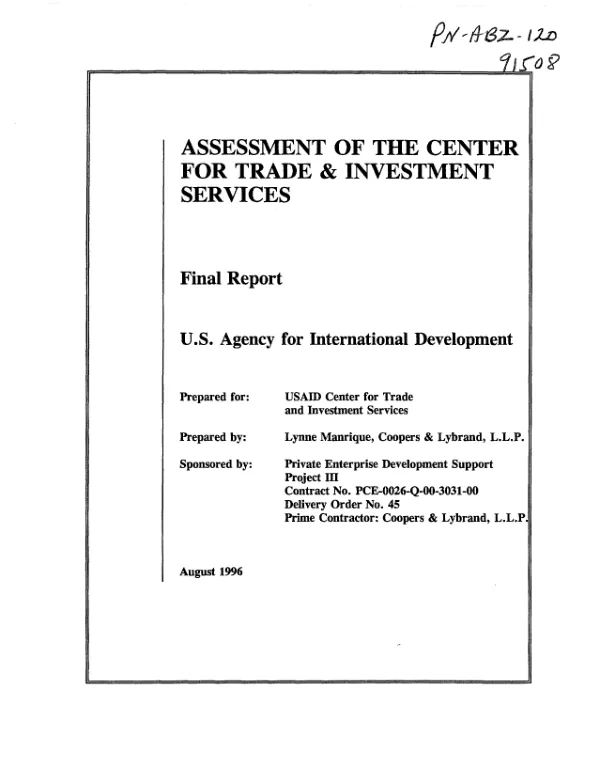
Assessment of the Center for Trade and Investment Services -- final report
Evaluates the Center for Trade and Investment Services (CTIS), which serves as USAID"s central point of contact for U.S.
Manrique, Lynne · 1996
Sign in to readA free account is required to download.
Abstract
businesses, NGOs, and individuals interested in business opportunities in developing countries. The Center, which was established in 1992, has broad geographical coverage and serves mostly (80%) private organizations (i.e., private companies, NGOs, and PVOs); most of its clients are small or medium-sized firms. Among both these organizations and USAID officials, the Center has gained a reputation for timeliness, breadth and quality of information, ability to tailor responses to specific requests, and a dedicated and skilled staff. Representatives of other federal agencies are more cautiously positive about CTIS because they do not know enough about the Center to comment definitively. The main impediment to CTIS operations is lack of familiarity with its name and/or operations. Since 1994, CTIS has disseminated environmental technology opportunity notices through the Environmental Technology Network for Asia (ETNA), which is operated in conjunction with the U.S.-Asia Environmental Partnership (USAEP). ETNA has reached its target audience -- small and medium-sized U.S firms and companies. Specifically, 82% of ETNA"s clients are small companies, while 11% are medium-sized and 7% are large; 33% of these firms are located in the West, 22% in the Midwest, 22% in the South, and 23% in the East. Companies were extremely enthusiastic regarding the ETNA trade lead program -- regardless of whether or not they had completed a sale as a result. Moreover, firms" positive perception of ETNA"s usefulness and effectiveness crossed the boundaries of size, geographic location, and (to a lesser extent) type of firm. ETNA trade opportunity notices seem to have helped business in three ways. (1) Many companies use the trade leads to glean up-to-date, difficult-to-obtain information about market demand in the countries that ETNA serves. (2) Businesses keep track of which Asian companies have requested U.S. services or products through ETNA in order to develop databases of companies that they might target in future marketing efforts. (3) ETNA helps companies by disseminating information about sales opportunities that are not widely advertised. Improvements could be made in the following areas. (1) Several representatives of U.S. firms viewed some of the trade leads as attempts by Asian companies to learn more about American environmental products to build market knowledge rather than for immediate needs. Since many U.S. companies in the ETNA network also use the trade leads for this purpose, many saw no harm in Asian companies doing the same. Within firms that used the trade leads primarily to complete sales in the short term, company representatives reported that they could quickly sift through the leads to answer only those they believed represented immediate opportunities. (2) Although company representatives recognized that they needed to take the lead in pursuing ETNA-related opportunities, some suggested that USAEP field representatives provide more follow-up assistance. In sum, CTIS and ETNA have developed a significant reputation and following among segments of their target audiences. A more mature organization, CTIS is now poised to strengthen and expand its client base and operations and polish its current activities prior to evaluating additional areas. By continuing their current activities and exploring and implementing new ones, CTIS and ETNA can encourage U.S. organizations to develop sustainable, mutually beneficial linkages with their counterparts in developing countries, thereby furthering the Agency"s overall development aims. (Author abstract, modified)
Related documents