USAID DEC
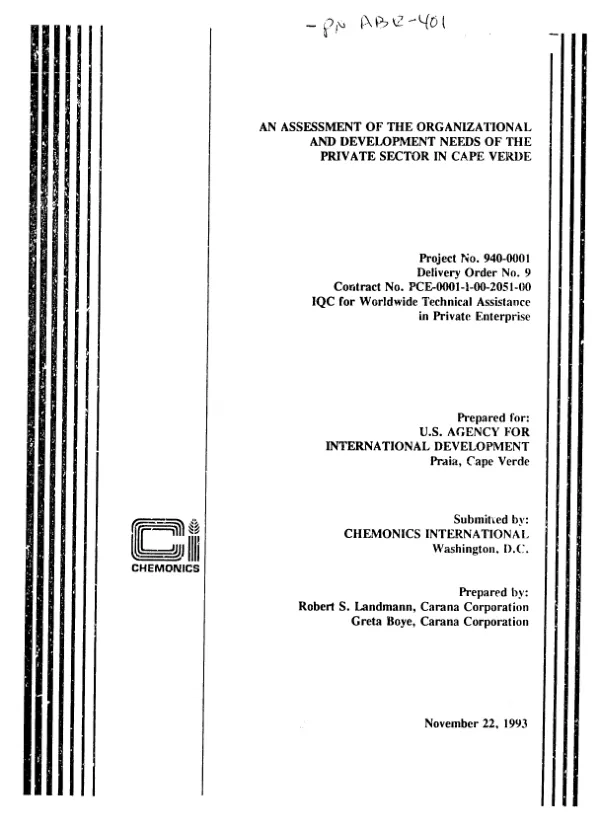
Assessment of the organizational and development needs of the private sector in Cape Verde
Sign inCARANA CORP.
Assessment of the organizational and development needs of the private sector in Cape Verde
Although the Government of Cape Verde (GOCV) has legislated several economic policy reforms, the reforms have not yet been implemented.
Landmann, Robert S.; Boye, Greta · 1993
Sign in to readA free account is required to download.
Abstract
Consequently, many cultural, historic, political, and economic obstacles still impede private sector performance; the country"s business community is still disorganized and inexperienced in export markets (the key to Cape Verde"s economic future); the state-dominated banking system continues to impede the flow of credit to business, primarily through onerous bureaucratic procedures and requirements; and the government"s export and investment agency, the Center for the Promotion of Exports (PROMEX), continues to be unable to attract foreign investment or to stimulate exports. Cape Verde"s economy has been largely an artificial one, shielded from realities of the market place, and supported by external transfers from donor agencies and the large expatriate community. The government and the state-owned enterprises have failed to stimulate and sustain productive growth. However, Cape Verde"s new government, the first in the country to be elected through free elections, has made significant progress, especially at the policy level, in bringing Cape Verde into the world economy, though much remains to be done. Private-sector driven development is Cape Verde"s only alternative for economic growth. (Author abstract)
![CBTPA [Caribbean Basin Trade Preference Act] action plan for Guyana](https://covers.devme.ai/gen/72654.webp)