COOPERS AND LYBRAND
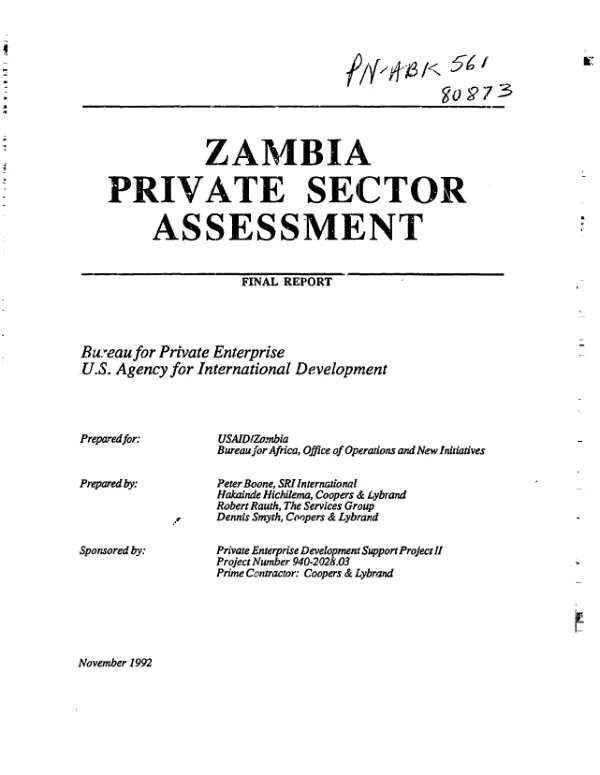
Zambia private sector assessment
Although Zambia entered a new economic and political era when it voted the Movement for Multiparty Democracy (MMD) into power in 1991, the country"s economy still suffers from distortions introduced during the Second Republic.
Boone, Peter; Hichilema, Hakainde · 1992
Sign in to readA free account is required to download.
Abstract
The four major constraints on the economy -- hyperinflation, external debt, overreliance on copper exports, and the dominance of parastatals -- cannot be removed immediately, but the MMD government has already introduced a bold set of stabilization and liberalization measures. This report investigates obstacles to and opportunities for private sector growth in Zambia. Section 2 describes the macroeconomic setting, MMD"s stabilization and privatization programs, and the roles of the public and private sectors in the economy. The third and fourth sections examine existing policy and financial constraints on private sector development. Section 5 assesses prospects for growth and investment in terms of labor, infrastructure, transportation, and regional market opportunities, and identifies agriculture, transportation, mining, and tourism as high potential sectors/subsectors. Section 6 presents policy recommendations for the financial sector, business establishment procedures, business taxation, the exchange rate, import and export controls, labor policy, property rights, and investment/export incentives. Section 7 briefly examines related donor activities in order to prevent USAID duplication of such assistance. Finally, the report suggests four program options for USAID: an export policy development project; assistance to post-privatized and export- oriented firms ("Champions"); non-bank financial mechanisms; and private sector nonproject assistance. Appendices list current business taxes and rates of deduction on capital expenditures.