USAID DEC
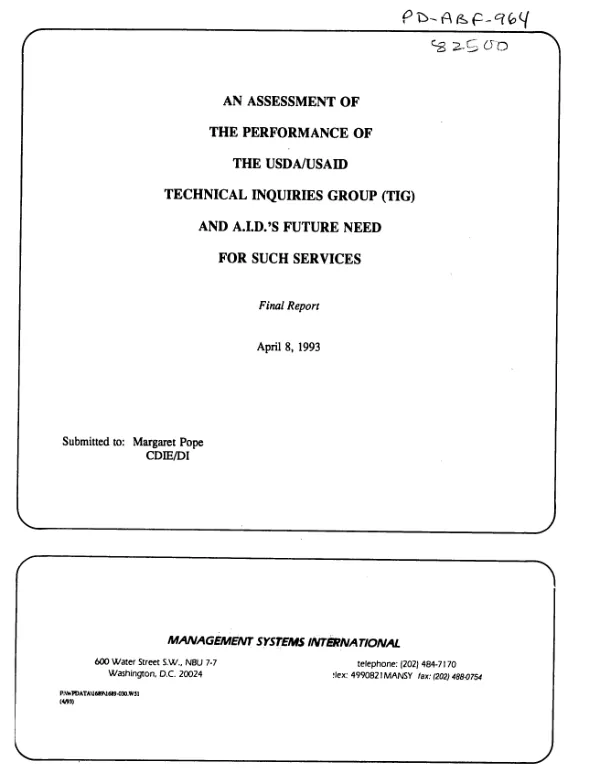
Assessment of the performance of the USDA/USAID Technical Inquiries Group (TIG) and AID's future need for such services
Sign inMANAGEMENT SYSTEMS INTERNATIONAL, INC. (MSI)
Assessment of the performance of the USDA/USAID Technical Inquiries Group (TIG) and AID's future need for such services
Evaluates the effectiveness, efficiency, and potential future role of the information services provided to A.I.D./W and Mission personnel by the U.S.
Hageboeck, Molly|Daniell, Douglas · 1993
Sign in to readA free account is required to download.
Abstract
Department of Agriculture's (USDA) Technical Inquiries Group (TIG). The assessment included a user survey, an examination of both the "real" and elapsed time associated with the preparation of nine randomly sampled TIG responses, and interviews with key informants in A.I.D.'s regional bureaus, as well as its central technical and policy offices. Findings indicate that TIG answers inquiries on a much broader range of topics than might be expected. Inquiries on policy issues and environmental questions are now as routine as questions on agricultural production, processing, and marketing. In regard to productivity, the data suggest that TIG now answers around 1,000 inquiries a year, double the level of 5 years ago. User surveys indicate that 80% of TIG's primary users are A.I.D. staff members, most of whom work in either agricultural or environment-related assignments. While TIG is not the only information resource upon which these users depend, many are repeat users of the service who characterize it as being very valuable. Most users point to program design and implementation as the key stages supported by TIG products, and report that the impact of TIG's products tends to be most visible during implementation. The main secondary users for TIG products are the host country officials with whom A.I.D. users share the answers they receive from the TIG service. By and large, TIG users give the service high marks for quality and considered its responses to be timely. Examination of TIG's efficiency and the level of demand for its services indicate that TIG is at least as efficient and cost-effective as other similar services, and may be more so than most. With respect to future demand for TIG's services, interviews with A.I.D. staff and a review of recent Congressional documents and early statements from Clinton administration officials suggest that both agriculture and environment will continue to have an important place in A.I.D.'s portfolio. Based on the findings of this assessment, it is concluded that the TIG program provides A.I.D. with high value products for which there is a continuing demand. It should, if financially feasible, be continued. In addition to these conclusions, the evaluation makes a series of observations about A.I.D.'s oversight of the many different topical and general information services it funds, and concludes that improvements are warranted. Absent an appropriate management mechanism, A.I.D. has inadequate documentation concerning, or control over, the full range, depth, cost and quality of such services. Unnecessary duplication is a possibility under such circumstances. It is also highly probable that many intended users are unaware of the services. The evaluation provides both TIG and A.I.D. with suggestions for improvements in oversight of such programs. (Author abstract, modified)