USAID. MISSION TO EL SALVADOR
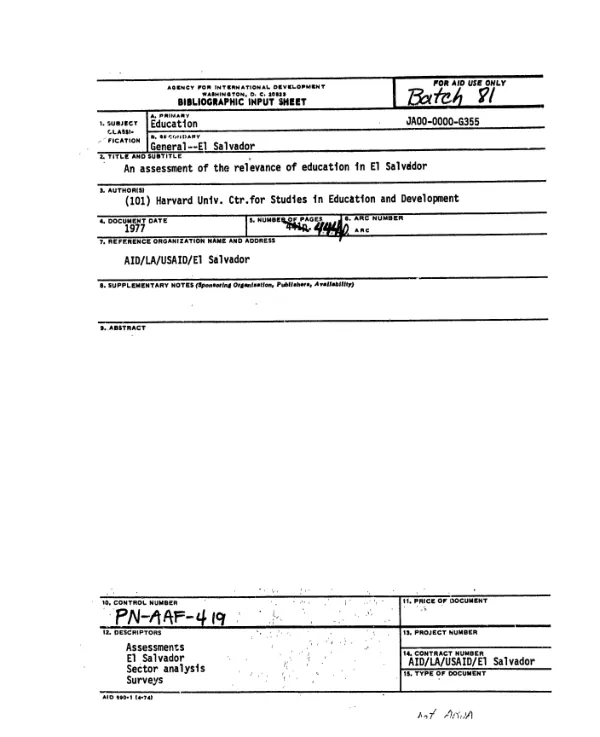
ASSESSMENT OF THE RELEVANCE OF EDUCATION IN EL SALVADOR
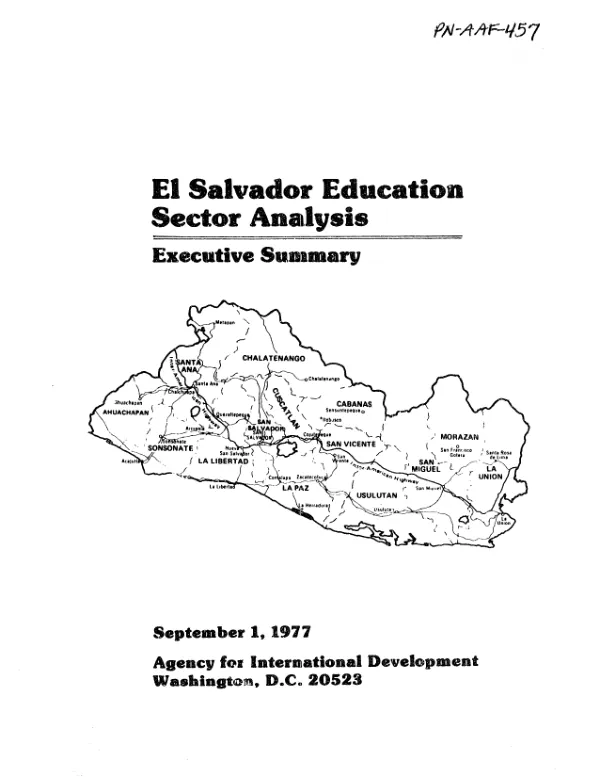
The El Salvador sector analysis investigated the status and functioning of education and training throughout the nation and was structured around three central themes: (1) the equity, coverage, or outreach of education in El Salvador; (2) the efficiency of schooling and training; and (3) the relevance of education and training in El Salvador.
1970
Sign in to readA free account is required to download.
Abstract
This report focuses on relevance. One of the major activities of this report was the development of a comprehensive design for analyzing educational relevance. Several attempts were made to assess the aspects, facets, and pieces of educational relevance, and this report pulls this work together. The most ambitious undertaking was the development and application of an achievement test in four curricular areas. Volumes of data were collected and analyzed to assess the coverage of Salvadorean education as revealed in the percentage of enrollments of various groups at various levels in the school system. The efficiency with which these enrollments were processed through the system, governed by the flow parameters of drop out, repetition and promotion, and measured by input-output indices and completion ratios, was also assessed. This assessment was matched with cost data and related to structural and organizational features of the system. Four bodies of data form the basis for this report: worker-employer study, high school follow-up study, audience for nonformal educational programs, and the work force study. There is also partial treatment of a fifth study on student households. The report includes the results of the analysis of the four major data collections and a summary of conclusions. Implications of the study are discussed in the final section.
Connected topics
![GOES [Government of El Salvador]/USAID Mission to El Salvador intermodal transportation study : final report -- task 5, port studies](https://covers.devme.ai/gen/16637.webp)