USAID. BUR. FOR PROGRAM AND POLICY COORDINATION
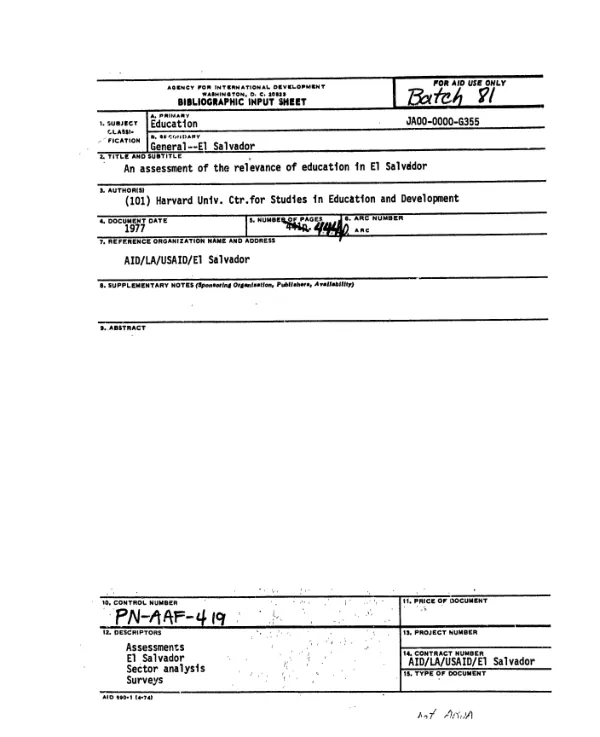
EL SALVADOR EDUCATION SECTOR ANALYSIS; EXECUTIVE SUMMARY AND STATUS REPORT, PART I
The El Salvador education sector analysis has two basic objectives: to obtain findings for increasing the efficiency, access and relevance of the education and training sector and to develop the Ministry"s capacity for data collection, data processing, and analytical interpretation aimed at continuous improvements in the formulation of policy and the allocation of resources.
ROBINSON, BRANDON · 1977
Sign in to readA free account is required to download.
Abstract
The final output will be fifteen analytical working documents written in Spanish. This paper is based on six working documents and deals with the maximization of the efficiency of basic education viewed as: maximizing academic performance or learning; minimizing dropout; minimizing repetition; and minimizing per-student cost. The final analysis will focus on the efficiency, access and relevance of kindergarten, basic education, high school, higher education, and non-formal education and training. Section III sketches some procedures for improving Ministry analysis, planning, and management. Because of the analysis the Ministry of Education has altered its view concerning the causes of the huge wastage or enrollment loss in the rural areas and now views it as mainly a problem of insufficient supply, not as a problem of demand. It plans to further expand educational services in the rural area, in part by completing all the incomplete schools, and in the future, by not building schools which have less than six grades. The analytical evidence indicates that a large scale shift to half-day schools will have neither an overall favorable nor unfavorable effect on learning, that it will reduce dropouts, and that it will probably reduce repetition. State owned buildings can be expected to provide a more appropriate physical layout for learning and teaching than rented buildings.